English has many words that look almost the same but have completely different meanings. Envelopes or envelopes is a good example. The two words differ by only one letter, so it is easy to type or write the wrong one.
If you want to mail a letter, you need an envelope. If you want to describe fog covering a town, you might say that the fog enveloped the town. The spelling may look confusing, but the difference becomes simple once you understand their jobs in a sentence.
In this guide, you will learn the meaning of envelope and envelope, how to pronounce them, when to use each word, common mistakes, real-life examples, and an easy way to remember the difference.
Quick Answer: Envelop or Envelope?
The correct word depends on what you mean.
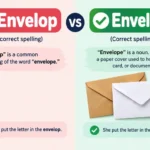
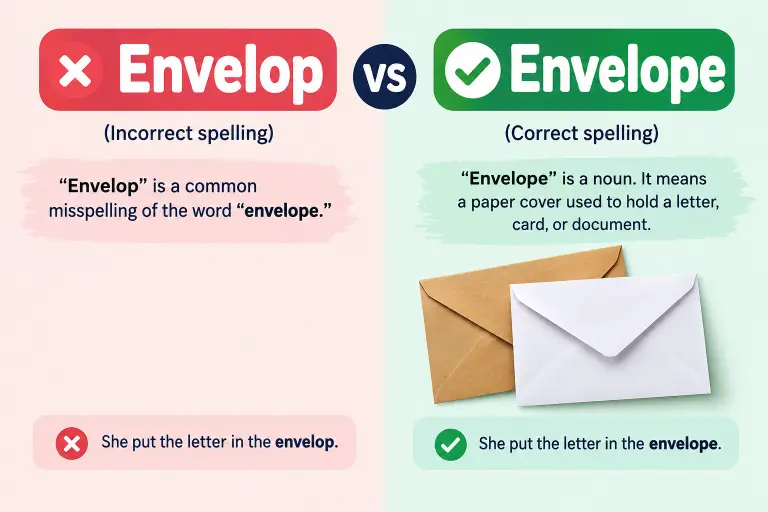
Envelope is usually a noun. It means a paper or similar container used to hold a letter, card, document, or other flat item.
Example: I put the letter in an envelope.
Envelop is a verb. It means to surround, cover, or completely wrap something.
Example: Dark clouds began to envelop the mountain.
Here is the basic difference:
| Word | Part of Speech | Meaning | Example |
| Envelope | Noun | A paper cover for a letter or document | She opened the envelope. |
| Envelop | Verb | To surround or cover completely | Fog began to envelop the road. |
So, if you are talking about something you put a letter inside, use an envelope. If you are talking about something surrounding or covering another thing, use an envelope.
Meaning of Envelope
Envelope is a noun. The most common meaning is a flat paper container used for mailing letters, cards, checks, invitations, and documents.
For example:
Please put the check in the envelope.
I received an envelope in the mail.
She wrote the address on the front of the envelope.
An envelope normally has a flap that can be folded and sealed. It protects the item inside and makes it easier to send through the mail.
The word can also have meanings outside ordinary mail. In some fields, envelope describes an outer covering, boundary, or shape around something.
For example, in mathematics, science, and engineering, an envelope can refer to a curve or boundary that surrounds or touches a family of curves or shapes. The exact meaning depends on the subject.
There is also a common phrase, “push the envelope.” It means to go beyond normal limits or test what is possible.
For example:
The new design pushes the envelope in computer technology.
In this expression, the envelope is still spelled with the final e.
Meaning of Envelop
Envelop is a verb. It means to surround, cover, or wrap something completely.
For example:
A thick fog began to envelop the city.
Here, the fog is surrounding the city.
Another example is:
The warm blanket enveloped the child.
The blanket surrounds or covers the child.
You can also use envelopes in a figurative way.
For example:
A feeling of sadness enveloped him.
This does not mean that sadness physically wrapped around him. It means the feeling became very strong and seemed to surround or overwhelm him.
The verb can appear in different forms, such as envelope, envelops, enveloped, and enveloping.
| Form | Example |
| Envelop | Clouds may envelop the peak. |
| Envelops | The mist envelops the valley. |
| Enveloped | Smoke enveloped the building. |
| Enveloping | The enveloping darkness made it hard to see. |
Notice that the verb does not become an envelope. The final e changes the word into a different noun.
Envelop vs Envelope: The Main Difference
The easiest way to understand these words is to focus on their grammatical roles.
Envelope names a thing.
Envelop describes an action.
Think of envelope as something you can hold in your hand. Think of envelope as something that happens when one thing surrounds another.
Consider these sentences:
I bought ten envelopes.
You can buy and hold envelopes.
The smoke began to envelop the room.
Smoke can surround the room.
Here is another comparison:
| Sentence | Correct Word | Why? |
| I put the card in an ___ | Envelope | It is a container. |
| Clouds began to ___ the mountain. | Envelop | Clouds surround the mountain. |
| She opened the ___ carefully. | Envelope | It is something she can open. |
| Darkness began to ___ the street. | Envelop | Darkness surrounds the street. |
| He mailed the document in an ___ | Envelope | The document goes inside it. |
| Fog ___ the village. | Enveloped | Fog covered or surrounded it. |
This simple question can help:
Am I naming a container, or am I describing an action?
If it is a container, use an envelope.
If it is an action of surrounding or covering, use envelop.
How to Use Envelope in a Sentence
Because envelope is a noun, it often appears after words such as an, the, this, that, my, or your.
For example:
I need an envelope.
The envelope is on the desk.
Where is my envelope?
This envelope has no address.
Please seal the envelope.
You can also make it plural:
I bought five envelopes.
The office has hundreds of envelopes.
The plural form is envelopes, with an s at the end.
One common mistake is to write envelopes when you mean the paper container.
Incorrect:
I put the check in an envelope.
Correct:
I put the check in an envelope.
The final e matters because it changes the word and its meaning.
How to Use Envelop in a Sentence
Envelop is a verb, so it normally describes something doing the action of surrounding or covering something else.
For example:
The fog enveloped the road.
Smoke enveloped the building.
The darkness enveloped the forest.
Warm air enveloped the room.
You can use the word in both physical and figurative situations.
A physical example is:
Heavy snow enveloped the trees.
The snow covers the trees.
A figurative example is:
A sense of calm enveloped the room.
Calm cannot physically wrap around a room, but the sentence describes a strong feeling that seems to fill or surround the space.
The verb is often used in descriptive writing because it can create a strong image without using many words.
Envelop or Envelope Pronunciation
Pronunciation is another useful way to separate these words.
Envelope is commonly pronounced in American English as “EN-vuh-lope.” The final part sounds like “lope.”
Envelop is commonly pronounced “en-VEL-uhp.” The final part sounds more like “up.”
So the words differ in both spelling, meaning, and pronunciation.
| Word | Common American English Pronunciation | Meaning |
| Envelope | EN-vuh-lope | A paper container |
| Envelop | en-VEL-uhp | To surround or cover |
Because the pronunciation is different, saying the words aloud can sometimes help you remember which one you need.
Common Mistakes With Envelop and Envelope
The most common mistake is using an envelope when referring to a mailing container.
For example:
Incorrect: Please put the invitation in the envelope.
Correct: Please put the invitation in the envelope.
Another mistake is adding an unnecessary final e when using the verb.
Incorrect: Dark clouds began to envelope the mountain.
Correct: Dark clouds began to envelop the mountain.
Why is the second sentence correct? Because envelope is the verb meaning “surround.”
There is one reason this mistake can be especially confusing: the word envelope looks like it could be the verb form of envelope. But it is not. They are separate words with different meanings.
A good habit is to identify the role of the word before choosing its spelling.
If the word is a thing, think envelope.
If the word is an action, think envelope.
Real-Life Examples of Envelope
You will most often see envelopes in everyday situations involving letters, mail, documents, invitations, or money.
Here are some examples:
She placed the birthday card inside an envelope.
The envelope was addressed to my sister.
Please write your name on the envelope.
He opened the envelope and read the letter.
The invitation arrived in a white envelope.
I need a larger envelope for these documents.
The company sent the contract in an envelope.
She sealed the envelope before leaving the house.
These examples all refer to a physical container.
The word can also appear in common expressions. For example, “push the envelope” means to test or extend accepted limits.
The engineer wanted to push the envelope with the new design.
This expression is common in English and does not refer to mailing a letter.
Real-Life Examples of Envelop
The verb envelop is useful when you want to describe something that surrounds, covers, or seems to surround something else.
For example:
Mist began to envelop the hills.
Smoke quickly enveloped the room.
The darkness enveloped the empty street.
A warm blanket enveloped the baby.
The crowd enveloped the small group of performers.
A strange silence enveloped the room.
Thick clouds enveloped the mountain peak.
In these sentences, the subject is doing the surrounding or covering.
This is an important clue. If you can replace the word with surround, cover, or wrap around, envelope may be the word you need.
For example:
Fog enveloped the town.
You could say:
Fog surrounded the town.
The meaning is very similar.
A Simple Trick to Remember the Difference
One easy memory trick is to connect envelopes with mail.
When you think about a letter, card, or document, think:
Envelope = a thing that holds something.
When you think about clouds, fog, smoke, darkness, or another force surrounding something, think:
Envelop = to surround something.
You can also remember the word “velop” as an action in this context.
Try these pairs:
Letter → envelope
Fog → envelop
Card → envelope
Smoke → envelop
Document → envelope
Darkness → envelop
This method makes the difference much easier to remember.
Envelope or Envelop in Professional Writing
Both words can appear in professional writing, but they are used in different ways.
Envelope is common in business communication when discussing letters, documents, invoices, invitations, checks, or mailing materials.
For example:
Please place the signed form in the enclosed envelope.
The client received the documents in a sealed envelope.
Write the return address on the envelope.
Envelop is more common in descriptive or formal writing.
For example:
A layer of fog began to envelop the area.
The sound seemed to envelop the entire hall.
In everyday business writing, you will probably use envelopes more often. The verb envelop is less common in casual conversation but remains a correct and useful English word.
Is Envelope Always a Noun?
In standard modern English, envelope is primarily used as a noun.
Its common meaning is a container or outer covering. It can also have specialized meanings in areas such as mathematics, physics, engineering, and aviation.
For example, the phrase “flight envelope” is used in aviation to describe the operating limits within which an aircraft is designed to fly.
The phrase “envelope of a curve” has a specialized mathematical meaning.
So while the everyday meaning is a paper container, the word has several technical uses.
These meanings should not be confused with the verb envelop.
Is Enveloping a Common Word?
Envelop is a real English verb, but it is less common in everyday conversation than envelope.
People may use simpler words such as cover, surround, or wrap instead.
For example:
Fog covered the road.
Fog surrounded the road.
Fog enveloped the road.
All three can describe a similar idea, although envelopes can sound more descriptive or literary.
Because of this, you may see envelopes more often in books, news writing, formal descriptions, and creative writing than in casual speech.
British vs American English
The basic difference between envelope and envelope is the same in both American and British English.
Envelope is the noun for the paper container.
Envelop is the verb meaning to surround or cover.
There can be differences in how envelope is pronounced in different English-speaking regions, but the spelling and basic meanings remain distinct.
For American English learners, the most useful point is simple: do not choose between the two based on British versus American spelling. Choose based on the meaning and grammatical role.
Envelop or Envelope: Common Sentence Corrections
Looking at incorrect and corrected sentences can make the difference clearer.
Incorrect: I put the letter inside an envelope.
Correct: I put the letter inside an envelope.
The word refers to a container.
Incorrect: Fog began to envelope the valley.
Correct: Fog began to envelop the valley.
Here, the word is a verb meaning “surround.”
Incorrect: She opened the envelope.
Correct: She opened the envelope.
Incorrect: Darkness enveloped the room.
Correct: Darkness enveloped the room.
The last sentence is already correct because enveloped is the past-tense form of envelope.
Envelop vs Envelope: Quick Comparison
| Feature | Envelop | Envelope |
| Part of speech | Verb | Noun |
| Main meaning | To surround or cover | A container for letters or documents |
| Common example | Fog enveloped the town. | The letter is in the envelope. |
| Final letter | No final e | Final e |
| Past tense | Enveloped | Not normally a verb |
| Related idea | Surround | Container |
The key difference is not just spelling. The words perform different jobs in a sentence.
FAQs About Envelop or Envelope
Is it an envelope or an envelope for a letter?
The correct word is envelope. A letter goes inside an envelope.
Example: I put the letter in an envelope.
What does envelope mean?
Envelop is a verb meaning to surround, cover, or wrap something completely.
Example: Fog enveloped the road.
Is “envelope” a correct English word?
Yes. Envelop is a standard English verb. It means to surround or cover something.
Is “envelope” a verb?
In ordinary modern English, envelope is mainly a noun. It refers to a container or outer covering. The verb meaning “to surround” is spelled envelop.
How do you remember envelope vs envelope?
Remember envelopes for mail, letters, and documents. Remember the envelope for something that surrounds or covers another thing.
What is the difference between enveloped and envelope?
Enveloped is the past tense of the verb envelop, meaning surrounded or covered. Envelope is a noun that usually means a paper container.
For example:
The fog enveloped the house.
The letter was inside an envelope.
Conclusion
The difference between envelop or envelope is simple once you focus on meaning. Envelope is a noun. It usually means the paper container used for letters, cards, checks, and documents. Envelop is a verb that means to surround, cover, or wrap something.
When you see a letter, think of an envelope. When you see fog, smoke, darkness, clouds, or another thing surrounding something, think of the envelope. Remembering this basic difference will help you avoid one of the most common spelling mix-ups between these two words.
If you are unsure, ask yourself one question: Am I naming a container, or describing something that surrounds another thing? That quick check will usually give you the correct answer.