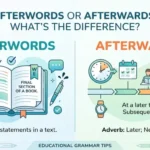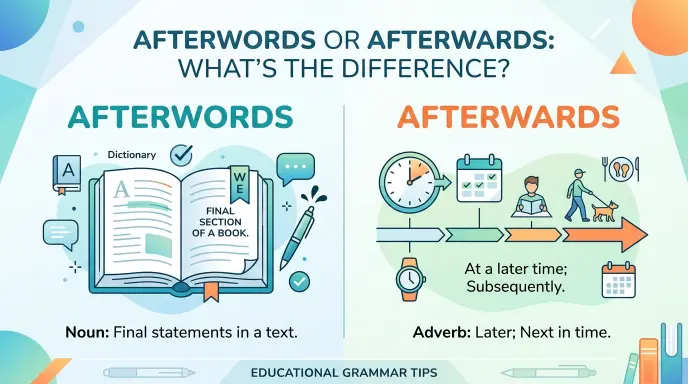
Have you ever wondered whether afterwords or afterwards is the correct spelling? You are not alone. These two words look almost identical, but they have completely different meanings and grammatical roles. One is usually connected to the ending of a book, while the other means “later” or “after something happens.”
The good news is that the difference is easy to remember once you see a few simple examples. Afterwards is an adverb that means later or at a later time. Afterword is a noun that refers to a short section written at the end of a book. Its plural form is afterwords.
In this guide, you will learn the meaning of afterwords and afterwards, how to use each word correctly, common mistakes, examples, and the small difference between American and British English.
Quick Answer: Afterwords or Afterwards?
If you mean “later” or “after that,” use afterwards.
If you mean “sections at the end of books,” use afterwords.
For example:
We went out for dinner afterwards.
Here, afterwards means “later.”
The author included two afterwords in the new edition.
Here, afterwords means written sections that appear at the end of a book.
The easiest way to remember the difference is this: afterwards describes when something happens, while afterwords are written words that come after the main part of a book.
| Word | Part of speech | Meaning | Example |
| Afterwards | Adverb | Later; after that | We went home afterwards. |
| Afterword | Noun | A section at the end of a book | The author wrote an afterword. |
| Afterwords | Plural noun | More than one afterword | The book contains two afterwords. |
Meaning of Afterwards
Afterwards is an adverb. It means later, after that, or at a later time.
It is used when you want to explain that one event happens after another event.
For example:
We watched a movie and went for ice cream afterwards.
The word afterwards tells us that going for ice cream happened after watching the movie.
Here are some more examples:
I finished my homework and played video games afterwards.
She went to the store and called her mother afterwards.
They had dinner and took a walk afterwards.
He apologized afterwards.
In each sentence, afterwards refers to a time that comes after an earlier event.
You can often replace afterwards with later or after that, although the sentence may sound slightly different.
For example:
We went home afterwards.
can become:
We went home later.
or:
We went home after that.
All three versions can express a similar idea.
Meaning of Afterword and Afterwords
An afterword is a short section that appears at the end of a book or other written work. It is usually written after the main text and may explain the book, its background, its creation, or its importance.
The plural form is afterwords.
For example:
The author added an afterword to the second edition.
This means the author added a section at the end of the book.
If a book has more than one such section, you can say:
The new edition contains several afterwords.
An afterword is different from the main story or main content. It comes after the main text and may give readers extra information or a final perspective.
The word afterword is made from two parts: after + word. This can help you remember that an afterword is literally a set of words that comes after the main written work.
| Term | What it refers to | Example |
| Afterword | One section at the end of a book | The writer added an afterword. |
| Afterwords | Two or more such sections | The book includes several afterwords. |
| Afterwards | A time after an event | We talked afterwards. |
Grammar: How to Use Afterwards Correctly
Because afterwards is an adverb, it usually describes when an action happens.
It can appear at the beginning, middle, or end of a sentence, although the end is very common in everyday English.
For example:
Afterwards, we went home.
We afterwards discovered that the store was closed.
We went home afterwards.
The first and third examples sound especially natural in everyday American English.
You can also use afterwards after a phrase that describes an earlier action:
She finished her test and checked her answers afterwards.
He cleaned his room and watched television afterwards.
We ate lunch and went shopping afterwards.
The important point is that afterwards does not name a person, object, or book section. It tells you when something happens.
A simple test is to replace the word with later. If the sentence still makes sense, afterwards may be the word you need.
For example:
I called her afterwards.
Replace it:
I called her later.
The meaning still works, so afterwards is correct.
Grammar: How to Use Afterword and Afterwords Correctly
Afterword is a noun, so it names a thing: a section of writing at the end of a book.
Use afterword when you are talking about one section.
The author wrote an afterword for the new edition.
Use afterwords when you are talking about more than one.
The collection contains several afterwords.
You can usually identify afterword by looking for words such as the, an, an author’s, this, that, several, or two before it.
For example:
I enjoyed the afterword.
She wrote an afterword.
The book has two afterwords.
These examples all use the word as a noun.
Unlike afterwards, an afterword is not about time. It is a piece of writing.
Afterwords vs. Afterwards: The Main Difference
The biggest difference is meaning.
Afterwards is about time.
Afterwords is about writing.
Compare these two sentences:
We talked afterwards.
We read the afterwords.
In the first sentence, afterwards means that the talking happened later.
In the second sentence, afterwords means written sections found at the end of a book or work.
The spelling can be confusing because the words look so similar. The extra s in afterwords is part of the plural noun afterword. It does not make the word mean “later.”
A useful memory trick is:
After + words = written words at the end.
After + wards = later in time.
| If you mean… | Use… | Example |
| Later | Afterwards | I’ll call you afterwards. |
| After that | Afterwards | We ate afterwards. |
| A book’s final section | Afterword | I read the afterword. |
| More than one final section | Afterwords | The book has three afterwords. |
Afterward vs. Afterwards
There is another spelling that can cause confusion: afterward.
In American English, afterward and afterwards are both used and have the same basic meaning: later or after that.
For example:
We went to the restaurant afterward.
and:
We went to the restaurant afterwards.
Both sentences can mean the same thing.
Afterward is very common in American English, while afterwards is also correct. The choice often depends on personal or regional writing style.
The important thing is not to confuse either word with afterword.
| Word | Meaning | Example |
| Afterward | Later | We talked afterward. |
| Afterwards | Later | We talked afterwards. |
| Afterword | A section at the end of a book | I read the afterword. |
| Afterwords | More than one afterword | I read the afterwords. |
American English: Is Afterwards Correct?
Yes. Afterwards is correct English in the United States.
American English also commonly uses afterward, especially in some formal or edited writing. However, afterwards is not incorrect simply because it ends in -s.
For example, these are both acceptable:
We can discuss it afterward.
We can discuss it afterwards.
The meaning is essentially the same.
When writing for an American audience, you can use either afterward or afterwards. The main thing is to use the word consistently and correctly.
For the noun, however, the distinction remains important:
I read the afterword.
This means you read a section at the end of a book.
I read it afterwards.
This means you read something later.
Changing the spelling changes the meaning.
British English and Afterwards
Afterwards is especially common in British English, but it is also used in American English.
British and American writers may differ in how often they choose afterward or afterwards, but both forms are understood.
For everyday writing, there is no need to worry about this difference too much. If your meaning is later, both afterward and afterwards can work.
If your meaning is a section at the end of a book, use afterword or afterwords.
This is a meaning difference, not simply an American-versus-British spelling difference.
Common Mistakes With Afterwords and Afterwards
One common mistake is using afterwords when you mean later.
Incorrect:
I will call you afterwords.
Correct:
I will call you afterwards.
Another mistake is using afterwards when talking about a book section.
Incorrect:
The author added an afterwards.
Correct:
The author added an afterword.
If there is more than one section:
The author added several afterwords.
The spelling is small, but the meaning is very different.
Another mistake is thinking that the s in afterwards makes it plural. It does not. Afterwards is an adverb. It does not work like a regular plural noun.
For example, you would not say:
We had two afterwards.
That does not make sense because afterwards does not mean two things.
Instead, you might say:
We had two afterwords.
if you are talking about two written sections.
Real-Life Examples of Afterwards
Here are some natural examples of afterwards:
I went to the gym afterwards.
She called me afterwards.
We can talk about it afterwards.
He felt tired afterwards.
They went home afterwards.
I took a shower afterwards.
We had dessert afterwards.
She apologized afterwards.
In all of these sentences, afterwards means something happened at a later time.
You can usually replace it with later:
She called me later.
He felt tired later.
We had dessert later.
However, later can sometimes have a broader meaning than afterwards, so the exact choice depends on context.
Real-Life Examples of Afterword and Afterwords
Here are examples of afterword as a noun:
I enjoyed the author’s afterword.
The book ends with an afterword.
The writer included an afterword in the new edition.
The afterword explains how the story was developed.
For the plural:
The collection includes several afterwords.
I read all the afterwords at the end of the book.
The new edition has two afterwords.
These examples all refer to written material rather than a point in time.
How to Remember the Difference Easily
If you often mix up afterwords and afterwards, use a simple memory trick.
Think of afterwards as a time word.
You could say:
We will talk afterwards.
Think of afterword as a book word.
You could say:
I read the afterword.
The word afterword contains word, which makes it easier to connect with writing.
Another quick test is to ask yourself:
Am I talking about when something happens?
If yes, use afterwards.
Am I talking about writing at the end of a book?
If yes, use afterword or afterwords.
This simple question will solve most cases.
Afterwords or Afterwards in a Sentence
The following examples show the difference clearly:
We went shopping afterwards.
Here, the word means later.
We read the afterwords after finishing the book.
Here, the word refers to sections of writing.
I’ll send you the information afterwards.
Here, it means later.
The author included two afterwords.
Here, it means two sections at the end of a written work.
Notice that the words may look almost the same, but their jobs are different.
Tips for Choosing the Right Word
When you are unsure, first look at the meaning of your sentence.
If you can replace the word with later, choose afterward or afterwards.
For example:
I’ll finish it afterwards.
You can say:
I’ll finish it later.
That tells you afterwards is correct.
If you are talking about a section of a book, choose afterword.
For example:
The afterword gives more information about the story.
If you are talking about several such sections, choose afterwords.
For example:
The book contains three afterwords.
You can also remember that afterwards is an adverb, while afterword is a noun.
| Question | Correct choice |
| Does it mean “later”? | Afterwards |
| Does it mean “after that”? | Afterwards |
| Is it a section at the end of a book? | Afterword |
| Are there several book sections? | Afterwords |
| Can “later” replace it? | Usually afterwards |
| Is it a thing you can read? | Afterword |
FAQs About Afterwords or Afterwards
Is “afterwords” a correct word?
Yes. Afterwords is the plural form of afterword. It refers to two or more sections of writing placed at the end of a book or similar work.
Is “afterwards” one word?
Yes. Afterwards is normally written as one word. It is an adverb meaning “later” or “after that.”
What is the difference between afterword and afterwards?
Afterword is a noun for a section at the end of a book. Afterwards is an adverb meaning later or after something has happened.
Is afterward or afterwards correct in American English?
Both afterward and afterwards are correct and commonly understood in American English. They generally have the same meaning.
Should I say “read the afterwards” or “read the afterword”?
If you mean a section at the end of a book, say read the afterword. If there is more than one, say read the afterwords.
How can I remember afterwords vs. afterwards?
Remember that afterword contains word, so it refers to written material. Afterwards refers to time and means “later.”
Conclusion
The difference between afterwords or afterwards is simple once you focus on meaning. Afterwards is an adverb that means later or after that. Afterword is a noun that describes a section of writing placed at the end of a book, and afterwords is its plural form.
For example, you can say, “We went home afterwards” when you mean that you went home later. If you are talking about a book, you can say, “I read the afterword.” When there is more than one such section, use “afterwords.”
Also remember that afterward is another correct form meaning later, especially common in American English. When in doubt, ask yourself whether you are talking about time or written words. That quick test will help you choose the correct word every time.