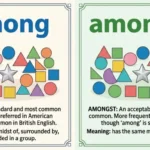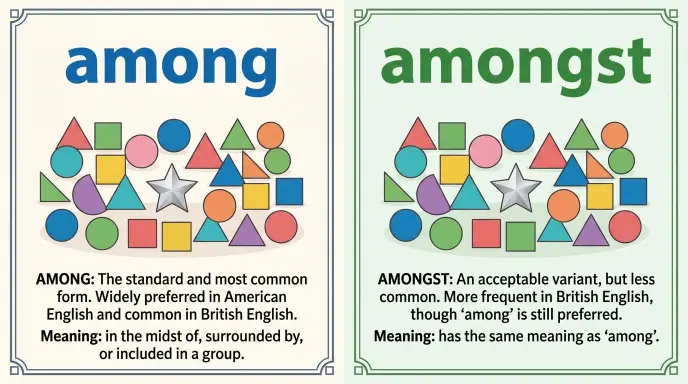
Choosing between amongst or among can be confusing because both words have the same basic meaning. The good news is that both among and amongst are grammatically correct. The main difference is style and usage. Among is much more common in modern American English, while amongst often sounds more formal, traditional, or British. In most everyday U.S. writing and conversation, among is the natural choice.
If you are unsure which word to use, choose among. It works well in school writing, business communication, websites, emails, conversations, and most other situations. This guide explains the meaning of both words, their history, grammar rules, differences, common mistakes, and many easy examples.
Quick Answer
Among and amongst are both correct prepositions. They usually mean in the middle of, surrounded by, or included with several people or things.
For example:
She found her keys among the books.
You can also write:
She found her keys amongst the books.
Both sentences are grammatically correct and have nearly the same meaning. However, the first sentence sounds more natural to most American English speakers.
| Word | Correct? | Common in American English? | General style |
| Among | Yes | Very common | Modern and natural |
| Amongst | Yes | Less common | Formal or traditional |
The easiest rule is simple: Use among for normal modern American English. Use amongst when you intentionally want a more formal, literary, or traditional tone.
Meaning and Definition of Among
Among is a preposition used when someone or something is surrounded by, included with, or connected to several people or things.
For example, if you say, He was sitting among his friends, you mean that he was sitting in the group of his friends.
Here are a few simple examples:
She walked among the trees.
The teacher stood among the students.
I found my wallet among the papers.
The house was hidden among the hills.
In each sentence, among shows a relationship between one person or thing and a group.
The word can also describe being included in a group.
For example:
She is among the best students in her class.
This means she is included in the group of the best students.
Among can also be used when something is shared or discussed within a group.
For example:
The news spread quickly among the workers.
The decision caused disagreement among the members.
The money was divided among the children.
In simple terms, among often means in or surrounded by a group.
Meaning and Definition of Amongst
Amongst has almost the same meaning as among. It can mean surrounded by several people or things, included in a group, or existing within a group.
For example:
She walked amongst the trees.
He felt comfortable amongst his friends.
The message spread quickly amongst the students.
The meaning is almost identical to the sentences using among.
The important difference is not usually the meaning. It is style and frequency.
Amongst is less common in everyday American English. It can sound more formal, old-fashioned, literary, or British depending on the sentence and speaker.
| Example with among | Example with amongst | Meaning |
| She stood among the crowd. | She stood amongst the crowd. | She was part of the crowd. |
| The flowers grew among the rocks. | The flowers grew amongst the rocks. | The flowers were surrounded by rocks. |
| He felt safe among his friends. | He felt safe amongst his friends. | He felt safe with his group of friends. |
| The secret spread among the workers. | The secret spread amongst the workers. | The secret became known within the group. |
Because the meanings are so close, choosing between them usually depends on the style you want.
Amongst or Among: What Is the Difference?
The biggest difference between amongst and among is modern usage.
Among them is the standard choice in American English. It is common in everyday speech, academic writing, news writing, business writing, and online content.
Amongst is also correct, but it is less common in American English. It may give a sentence a more formal, literary, or traditional feeling.
For example:
The children played among the trees.
This sounds natural and ordinary.
The children played amongst the trees.
This is also correct, but it may sound slightly more literary.
Another example is:
There was an argument among the team members.
This is a natural modern sentence.
There was an argument amongst the team members.
This is grammatically correct, but some American readers may find it more formal than necessary.
So, if your goal is clear and natural American English, among is usually the better everyday choice.
Grammar and Correct Usage
Both among and amongst are prepositions. They normally appear before a noun or pronoun to show a relationship with a group.
For example:
The teacher walked among the students.
Here, it connects the teacher with the group of students.
You can use among when talking about people:
She was popular among her classmates.
You can use it with objects:
The letter was hidden among the books.
You can use it with places or natural objects:
A small village was located among the mountains.
You can also use it with abstract ideas:
There is disagreement among the experts.
The same basic grammar applies to amongst.
For example:
There was disagreement amongst the experts.
Both sentences are correct.
A useful way to remember the grammar is:
among a group
Examples include:
among friends
among students
among the trees
among the choices
among the people
among the many options
Among can also appear before plural nouns and group expressions.
For example:
She shared the food among the guests.
The teacher divided the students among three groups.
The money was divided among the children.
When Should You Use Among?
Use among when you want your writing to sound natural, modern, and easy to understand.
This is especially useful in American English.
Among is a good choice for school assignments, websites, emails, business documents, social media posts, and everyday conversations.
For example:
The teacher walked among the students.
Choose one answer among the available options.
The news spread among the employees.
She felt comfortable among her new friends.
He searched among the boxes for his old photographs.
In all these examples, among sounds natural without drawing attention to the word itself.
If you are writing for a general American audience and you have no special reason to use amongst, choose among.
When Should You Use Amongst?
Use amongst when its style fits your writing.
Amongst can be useful when you want a more traditional, formal, or literary sound. It is also more familiar in some varieties of British English.
For example:
The castle stood amongst the hills.
The writer lived amongst artists and musicians.
Peace was difficult to find amongst the chaos.
These sentences are grammatically correct.
However, using amongst does not automatically make writing better or more professional. In many American contexts, among is clearer and more natural.
If you are writing a simple article, email, school paper, or business message, there is usually no need to replace among with amongst.
British vs. American English
The difference becomes more noticeable when comparing British and American English.
Both among and amongst are used in British English. Amongst can feel more natural in British writing than it does in everyday American English.
American English strongly favors among in most ordinary situations.
For example, an American writer would commonly say:
She was among her closest friends.
A British writer may also use:
She was amongst her closest friends.
Neither sentence is grammatically wrong.
It is important not to think of amongst as incorrect. It is a legitimate English word with a long history of use. The issue is mainly one of frequency, style, and regional preference.
| Situation | Common American choice | Possible alternative |
| Everyday conversation | Among | Amongst |
| Business writing | Among | Amongst |
| School writing | Among | Amongst |
| Formal writing | Among | Amongst |
| Literary writing | Among | Amongst |
| British English | Among | Amongst |
For readers in the United States, among is usually the safest and most natural choice.
Origin and History of Among and Amongst
The words among and amongst are closely related. Both developed from older forms of English that expressed the idea of being in the middle of or surrounded by a group.
Over time, English developed several related forms, including among, amongst, amid, and amidst.
The ending -st in amongst is an older form that also appears in words such as amidst and, historically, other forms of English vocabulary.
Today, the important point for everyday writers is that both forms remain valid.
Language changes over time, and frequency can change even when a word remains grammatically correct. That is why among is now the more common choice in American English, while amongst continues to appear in formal, literary, and British contexts.
You do not need to avoid it completely. You simply need to understand the tone it can create.
Common Mistakes With Among and Amongst
One common mistake is believing that amongst is always wrong.
It is not.
For example:
Amongst the flowers, she found a small bird.
This sentence is grammatically acceptable.
Another mistake is believing that among is only used for people.
That is also incorrect.
You can use it with people, objects, animals, places, and abstract groups.
For example:
The bird disappeared among the trees.
The coin was hidden among the stones.
The issue caused disagreement among the members.
Another mistake is using either word when a different preposition is needed.
For example, when talking about a relationship between exactly two people or things, between is often more appropriate.
For example:
The agreement was made between John and Sarah.
When referring to a larger group, among can be appropriate:
The decision was discussed among the team members.
The traditional rule says between is for two and among is for more than two. Modern English is more flexible than this simple rule, but the distinction remains useful for basic writing.
Among vs. Between
Because these words are sometimes confused, it helps to compare them directly.
Between often describes a relationship involving two distinct people, things, places, or groups.
For example:
The choice is between tea and coffee.
Among usually describes something within a larger group.
For example:
The discussion continued among the students.
Here is a simple comparison:
| Word | Typical use | Example |
| Between | A relationship involving separate items or parties | The agreement was between two companies. |
| Among | A relationship within a group | The decision was discussed among the employees. |
There are more advanced cases where between can be used with more than two entities, so the two versus three rule is not absolute. Still, between for distinct relationships and among for a group is a helpful starting point for everyday English.
Real-Life Examples of Among
Here are examples that show how naturally among works in everyday American English.
The teacher moved among the desks.
She found her phone among the pillows.
There was excitement among the fans.
He was respected among his coworkers.
The cabin was hidden among the trees.
The rumor spread quickly among the students.
Choose one item among these options.
The money was divided among the three children.
The problem created tension among the team members.
She felt relaxed among her family.
Notice that among works with both physical and abstract relationships.
It can describe location:
The house stood among the trees.
It can describe a social group:
She was among her friends.
It can describe an opinion or condition within a group:
There was disagreement among the voters.
Real-Life Examples of Amongst
Amongst can be used in many of the same situations.
The house stood amongst the trees.
She felt peaceful amongst her friends.
The message spread amongst the workers.
He searched amongst the old papers.
The bird disappeared amongst the branches.
Trust was difficult to find amongst strangers.
These sentences are correct. However, many American readers would naturally choose among instead.
For example:
He searched among the old papers.
This sounds more ordinary in American English than:
He searched amongst the old papers.
The second sentence is not wrong. It simply has a slightly different style.
Which Word Sounds More Natural?
For most American readers, among sounds more natural.
That does not mean amongst is bad. It simply means that among is the more common everyday form.
Think about the audience and the tone.
If you are writing a casual email, choose among.
If you are writing a school assignment, among is usually the simple choice.
If you are writing a website article for American readers, among will usually sound natural.
If you are writing a story with a formal or old-fashioned voice, amongst may fit the style.
The best word is often the one that matches the voice of the sentence.
Tips for Choosing Among or Amongst
If you frequently hesitate between these two words, use a simple decision process.
First, ask whether you are writing for an American audience. If yes, among is usually the best default.
Second, think about the tone. If your sentence is casual, modern, or straightforward, use among.
Third, consider whether you deliberately want a literary or traditional sound. If so, amongst may work.
Fourth, do not change every instance of among into amongst just to make your writing sound sophisticated. Clear writing is usually more effective than unnecessarily formal writing.
Here is a quick guide:
| If your goal is… | Recommended word |
| Everyday American English | Among |
| Simple writing | Among |
| Business communication | Among |
| School writing | Among |
| Website content | Among |
| Traditional style | Amongst can work |
| Literary style | Amongst can work |
| British-style writing | Either, depending on context |
FAQs
Is among or amongst correct?
Both among and amongst are correct English words. They generally have the same meaning. Among is more common in modern American English, while amongst can sound more formal, traditional, or British.
Is amongst more formal than among?
Often, yes. Amongst can give writing a more formal, literary, or traditional feeling. However, it is not necessarily more correct or more professional than among.
Do Americans use amongst?
Yes, Americans do use amongst, but it is much less common than among in everyday American English. Most American writers will naturally choose among.
Should I use among in American English?
Yes. If you are writing for a general U.S. audience and you are unsure which word to choose, among is usually the safest and most natural option.
Can among and amongst be used in the same way?
In most cases, yes. They can usually replace one another without changing the basic meaning of a sentence.
For example:
She walked among the trees.
She walked amongst the trees.
Both sentences mean that she walked surrounded by or within the trees.
Is amongst old-fashioned?
It can sound old-fashioned or traditional to some American readers, but it is not an incorrect or obsolete word. It is still used today, especially in British English and in formal or literary writing.
Conclusion
When choosing between amongst or among, remember that both words are grammatically correct. Their meanings are almost the same, but their style and frequency are different.
Among is the more common choice in modern American English and works naturally in everyday conversation, school writing, business communication, and online content. Amongst can be used when you want a more formal, literary, traditional, or sometimes British style.
If you are writing for a U.S. audience and simply want the most natural option, choose among. You do not need to worry that amongst is wrong; it is simply less common.
The most important thing is to choose the word that matches your audience, purpose, and tone. When in doubt, keep your writing clear and simple: among is usually the easy choice.