If you are wondering whether whisk or whisk is correct, the answer is simple: whisk is the standard and correct spelling in modern English. A whisk is a kitchen tool used to mix, beat, or add air to food. Wisk is usually a misspelling of whisk, although it may appear in names, brands, or other proper uses. Knowing the correct spelling helps you write clearly in recipes, schoolwork, cooking instructions, and everyday messages.
The confusion is understandable because the word is pronounced with a quick “wisk” sound. When people hear the word, they may naturally spell it the way it sounds. However, English spelling does not always match pronunciation perfectly. In this guide, you will learn what whisk means, why whisk is usually incorrect, how to use the word in sentences, common mistakes to avoid, and easy ways to remember the correct spelling.
Quick Answer: Wisk or Whisk?
Whisk is the correct standard spelling when you mean the kitchen tool or the action of mixing something quickly with a whisk.
Wisk is generally considered a misspelling when used for the same meaning.
| Spelling | Standard English? | Meaning |
| whisk | Yes | A kitchen tool or the action of mixing quickly |
| wisk | Usually no | Common misspelling of “whisk” |
For example, you can write:
Correct: Whisk the eggs until they are smooth.
Incorrect: Wisk the eggs until they are smooth.
There is one important detail: Wisk can sometimes appear as part of a brand name, company name, username, or other proper name. In those cases, it may be intentionally spelled that way. But when you are talking about the normal English word used in cooking, whisk is the spelling you should use.
Meaning of Whisk
The word whisk has two closely related uses. It can be a noun, meaning a kitchen tool, or a verb, meaning to mix something with that tool.
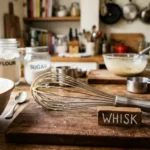
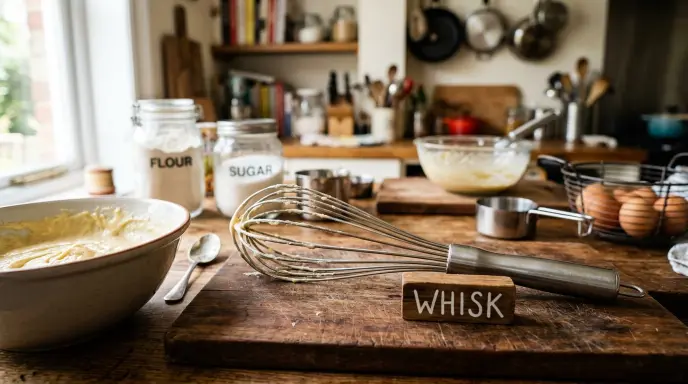
As a noun, a whisk is a cooking utensil made with several thin wires or similar loops. It is commonly used to beat eggs, mix sauces, combine ingredients, and add air to foods.
For example:
“Use a whisk to mix the eggs and milk.”
Here, whisk is a noun because it names the kitchen tool.
As a verb, whisk means to beat or mix something quickly. It can also mean to move someone or something away quickly in a different context.
For example:
“Whisk the eggs before adding them to the flour.”
Here, whisk is a verb because it describes an action.
| Word | Part of Speech | Example |
| whisk | Noun | I bought a new whisk. |
| whisk | Verb | Whisk the eggs for two minutes. |
In cooking, the word is especially common in recipes. You may see instructions such as “whisk together,” “whisk until smooth,” or “whisk constantly.”
Why Is Whisk Correct and Wisk Usually Wrong?
The main reason for the confusion is pronunciation. Whisk is pronounced roughly like “wisk,” so it can be tempting to remove the letter h when spelling it.
English has many words where spelling and pronunciation do not match perfectly. The extra h in whisk is part of the standard spelling.
Think of it this way:
Sound: wisk
Correct spelling: whisk
The same type of problem happens with many English words. People often spell words based on how they sound, but standard written English follows established spellings rather than simple sound patterns.
If you are writing a recipe, blog post, school assignment, menu, or cooking instruction, use whisk.
Whisk as a Noun
When whisk is used as a noun, it refers to a tool used for mixing or beating ingredients.
A traditional whisk has a handle and several thin wires. These wires help combine ingredients and can also introduce air into mixtures.
For example:
“I need a whisk for this pancake batter.”
“The chef picked up a whisk.”
“Where is the egg whisk?”
“The recipe says to use a whisk.”
In each sentence, whisk names an object.
There are different types of whisks designed for different cooking tasks. Some have wider shapes, while others are smaller and more specialized. The basic purpose, however, remains the same: helping you mix ingredients efficiently.
Whisk as a Verb
Whisk can also function as a verb. In this form, it describes the action of beating or mixing ingredients quickly.
For example:
“Whisk the eggs until they become light.”
“Whisk the flour into the sauce.”
“Whisk the dressing before serving.”
“Whisk the ingredients together in a large bowl.”
The word can be followed by an object. In “Whisk the eggs,” eggs is the object receiving the action.
You will often see whisk in cooking instructions because it gives a clear idea of how ingredients should be mixed.
Common Cooking Examples With Whisk
The word whisk appears in many everyday cooking situations. You might use a whisk when preparing breakfast, baking a cake, making a sauce, or mixing a salad dressing.
Here are some natural examples:
“Whisk the eggs with a little salt.”
“Whisk the milk into the flour mixture.”
“Whisk the sauce until it becomes smooth.”
“Whisk the dressing before pouring it over the salad.”
“Use a clean whisk to combine the ingredients.”
“Whisk the cream until it becomes thick.”
These examples show why whisk is useful in both recipes and normal conversation.
| Example | Use of “whisk” |
| Whisk the eggs. | Verb |
| I bought a whisk. | Noun |
| Whisk the sauce until smooth. | Verb |
| The whisk is in the drawer. | Noun |
| Use a whisk to mix the batter. | Noun |
Common Mistakes With Wisk and Whisk
The most common mistake is writing wisk when you mean the kitchen tool or mixing action.
For example:
Incorrect: Wisk the eggs in a bowl.
Correct: Whisk the eggs in a bowl.
Another common mistake is assuming that because a word sounds like “wisk,” its spelling should be wisk. English spelling often includes letters that are not obvious from pronunciation.
Another mistake is using whisk when a different cooking action is intended. Whisking usually involves beating or mixing quickly. It is not always the same as simply stirring.
For example, a recipe may tell you to stir soup slowly rather than whisk it. The correct cooking verb depends on the action the recipe requires.
Whisk vs Stir
Although whisk and stir are related, they are not always interchangeable.
To stir means to move a spoon or another utensil through a mixture, often in a gentle or steady way. To whisk usually means to beat or mix more actively, often using a whisk.
For example:
“Stir the soup slowly.”
“Whisk the eggs quickly.”
The choice of word can affect how the reader understands the cooking instruction.
| Action | Typical Meaning | Example |
| Stir | Move ingredients around gently or steadily | Stir the soup. |
| Whisk | Beat or mix quickly | Whisk the eggs. |
| Beat | Mix strongly, often to change texture | Beat the butter and sugar. |
| Fold | Mix gently without removing much air | Fold in the whipped cream. |
These words can overlap in some recipes, but they are not exact synonyms in every situation.
Whisk vs Beat
Another word that can cause confusion is beat.
Both whisk and beat can describe mixing ingredients. However, the tools and technique may differ.
You can whisk eggs with a wire whisk. You can also beat eggs with a fork, whisk, or electric mixer, depending on the recipe.
For example:
“Whisk the eggs until smooth.”
“Beat the butter and sugar until creamy.”
The word beat can describe a broader mixing action, while whisk often suggests using a whisk or a similar quick mixing motion.
Still, cooking language is flexible. Recipes sometimes use these words in slightly different ways depending on the desired texture and method.
Is Wisk Ever a Correct Word?
In standard everyday English, wisk is not the normal spelling for the kitchen tool or the cooking action. If you are writing a common English word, use whisk.
However, you may occasionally see Wisk written with a capital letter as part of a proper name, brand, business, product, username, or other name. A proper name can have a spelling that differs from a standard dictionary word.
That does not change the standard spelling of the cooking word.
So, if you are writing:
“Whisk the eggs.”
use whisk.
If you are referring to a specific company or product whose official name is spelled “Wisk,” keep that proper name as officially written.
The context matters.
British vs American English
There is no major American-versus-British spelling difference between whisk and wisk.
American English uses whisk.
British English also uses whisk.
So this is not like some words where American and British spelling differ, such as “color” and “colour.”
| English Variety | Standard Spelling |
| American English | whisk |
| British English | whisk |
| Canadian English | whisk |
| Australian English | whisk |
If you are writing for an American audience, whisk is the correct choice. The same spelling works for readers in other major English-speaking regions.
How to Remember the Correct Spelling
A simple memory trick can help you remember whisk.
Think of the phrase:
WHisk = WHisk the eggs.
The word begins with wh, not simply w.
You can also connect the spelling with another familiar word that starts with wh, such as:
“what”
“when”
“where”
“which”
“whisk”
This can make the spelling easier to remember.
Another useful trick is to picture the kitchen tool whenever you see the word whisk. The extra h becomes part of the visual pattern.
If you regularly write recipes, the correct spelling will quickly become automatic.
Real-Life Sentences Using Whisk
Learning a word becomes easier when you see it in normal sentences.
Here are several examples:
“I used a whisk to mix the pancake batter.”
“Whisk the eggs before adding the cheese.”
“She reached for the whisk in the kitchen drawer.”
“Whisk the sauce until it is completely smooth.”
“Do not stop whisking while you add the oil.”
“The recipe says to whisk the ingredients together.”
“Clean the whisk after making the sauce.”
“You can use a small whisk for this mixture.”
“The chef used a whisk to combine the ingredients.”
“Whisk the cream until it becomes thick.”
Notice that whisk can appear as both a noun and a verb. Its spelling stays the same.
Whisk in Recipes
If you read recipes online, you will often find the word whisk in instructions.
Common recipe phrases include:
“Whisk together.”
“Whisk until smooth.”
“Whisk constantly.”
“Whisk until combined.”
“Whisk the eggs.”
“Whisk in the milk.”
“Whisk over medium heat.”
The exact instruction depends on the recipe. For example, “whisk together” usually tells you to combine multiple ingredients. “Whisk until smooth” tells you to continue mixing until lumps or uneven areas are reduced.
Understanding these phrases can make recipes easier to follow.
Why Correct Spelling Matters
A spelling mistake may seem small, especially when wisk and whisk sound almost identical. However, correct spelling matters when you want your writing to look polished and trustworthy.
This is especially important for:
Cooking websites
Recipe blogs
School assignments
Cookbooks
Food menus
Product descriptions
Emails
Social media posts
Search engine content
Imagine a recipe website repeatedly using “wisk” instead of “whisk.” Readers may notice the error and question the quality of the rest of the content.
Using the standard spelling gives your writing a cleaner and more professional appearance.
Wisk or Whisk: A Simple Comparison
If you still feel unsure, this table gives you the main difference at a glance.
| Feature | Wisk | Whisk |
| Standard spelling for kitchen tool | No | Yes |
| Standard cooking verb | No | Yes |
| Used in recipes | Usually incorrect | Correct |
| Common dictionary spelling | No for this meaning | Yes |
| Pronunciation clue | Sounds similar | Standard written form |
| May appear as a proper name | Sometimes | Yes |
The easiest rule is:
When you mean the cooking tool or the action of mixing with it, spell it “whisk.”
FAQs About Wisk or Whisk
Is “wisk” or “whisk” correct?
Whisk is the correct standard spelling when you mean the kitchen tool or the action of mixing ingredients. “Wisk” is generally a misspelling in this context.
Why do people spell whisk as wisk?
People often write wisk because the word is pronounced in a way that makes the h easy to overlook. English spelling does not always follow pronunciation exactly.
Is whisk a noun or a verb?
Whisk can be both a noun and a verb. As a noun, it is a kitchen tool. As a verb, it means to mix or beat something quickly.
Can I write “wisk the eggs”?
No. In standard English, write “whisk the eggs.” The correct spelling includes the letter h.
Is whisk spelled differently in British English?
No. Whisk is the standard spelling in both American and British English. There is no major spelling difference between the two varieties for this word.
Is “wisk” ever used correctly?
It can appear as part of a proper name, brand, company name, product name, or other name. But when you mean the normal English cooking word, whisk is the correct spelling.
Conclusion
When choosing between wisk or whisk, remember that whisk is the standard spelling. It can refer to a kitchen tool used to mix ingredients, or it can describe the action of mixing or beating food quickly. The spelling stays whisk in both uses.
The confusion usually comes from pronunciation. The word sounds close to “wisk,” but the standard written form includes the letter h. This is why you should write “whisk the eggs,” not “wisk the eggs.”
If you are writing a recipe, food article, school assignment, or everyday message, whisk is the safe and correct choice. Keep the simple rule in mind: the kitchen tool is a whisk, and you whisk ingredients with it.