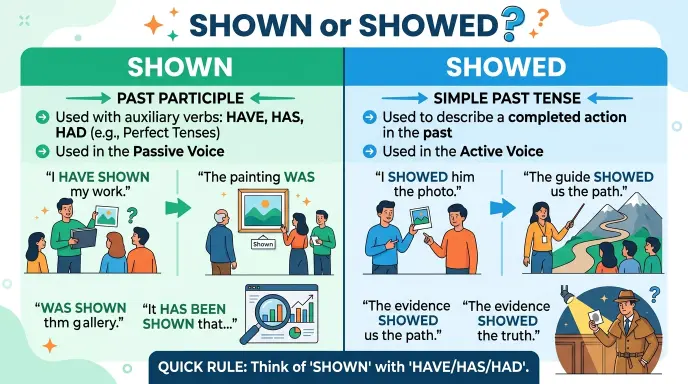
Many English learners wonder whether “shown or showed” is correct. The simple answer is that both are correct, but they are used in different grammar situations. “Showed” is usually the simple past tense, while “shown” is the past participle and normally appears with helping verbs such as has, have, had, or be. Understanding this small difference can make your writing and speaking much clearer.
In this guide, you will learn when to use shown or showed, how they work in American English, common mistakes to avoid, and plenty of easy examples. You will also see how these forms work in everyday sentences, questions, passive voice, and common expressions.
Quick Answer
The difference between shown and showed is mainly grammatical.
Showed is the simple past form of show.
Example: “She showed me her new phone.”
Shown is the past participle of show. It usually needs a helping verb.
Example: “She has shown me her new phone.”
Here is the basic pattern:
| Form | Grammar use | Example |
|---|---|---|
| Show | Base form | I want to show you something. |
| Shows | Present tense | He shows me his work. |
| Showed | Simple past | He showed me his work yesterday. |
| Shown | Past participle | He has shown me his work. |
A useful rule is simple: Use “showed” for a completed past action. Use “shown” after a form of “have” or in many passive constructions.
Meaning or Definition
The verb show means to let someone see something, explain something, display something, or make something clear.
For example, you can show someone a photograph, show a friend your house, show a student how to solve a problem, or show that you understand an idea.
The verb has several forms:
Show → showed → shown
These forms are called different verb forms because English changes verbs depending on how they are used.
“Showed” tells us that the action happened in the past.
For example:
“I showed him my new car.”
The action of showing happened in the past.
“Shown,” however, is not normally used alone as the simple past tense.
For example, this sentence is incorrect in standard American English:
“I shown him my new car.”
The correct sentence is:
“I showed him my new car.”
But “shown” becomes correct when it works with a helping verb:
“I have shown him my new car.”
The meaning is similar, but the grammar is different.
Grammar: When to Use Showed
Use showed when you are talking about a past action that happened at a specific time or as a completed event.
The basic pattern is:
Subject + showed + object
For example:
“She showed me her new dress.”
“They showed us their house.”
“He showed his teacher the project.”
“I showed my friend the picture.”
“We showed the visitors around the city.”
You can also use “showed” when the exact past time is mentioned.
“She showed me the message yesterday.”
“He showed us the results last week.”
“They showed the movie on Friday.”
The word “showed” works like other regular simple past forms when you are describing a completed event.
Here are more examples:
“I showed my brother how to use the camera.”
“Sarah showed me her new shoes.”
“The teacher showed the students an example.”
“My father showed me an old photograph.”
“The guide showed us where to go.”
In each sentence, the action happened in the past.
Grammar: When to Use Shown
Shown is the past participle form of “show.” It usually appears with a helping verb.
Common helping verbs include has, have, had, is, are, was, and were, depending on the sentence structure.
For example:
“She has shown great improvement.”
“I have shown him the answer.”
“They had shown us the room before dinner.”
“He was shown the correct way to use the machine.”
The most common pattern is:
has/have/had + shown
Examples:
“I have shown you the answer.”
“She has shown me the way.”
“They have shown excellent results.”
“He had shown interest in the project.”
“We had shown them the documents.”
The important point is that “shown” normally does not replace “showed” in a simple past sentence.
Compare these sentences:
| Incorrect or correct? | Sentence | Reason |
|---|---|---|
| ❌ | I shown him the picture. | “Shown” cannot normally stand alone as simple past. |
| ✅ | I showed him the picture. | “Showed” is the simple past form. |
| ✅ | I have shown him the picture. | “Shown” follows “have.” |
| ✅ | I had shown him the picture. | “Shown” follows “had.” |
| ❌ | She shown me yesterday. | Simple past requires “showed.” |
| ✅ | She showed me yesterday. | Correct simple past. |
Showed vs Shown in Everyday English
In everyday American English, both words are common, but their sentence structures are different.
Consider this example:
“I showed Tom the photo.”
This tells us that the showing happened in the past.
Now compare:
“I have shown Tom the photo.”
This uses the present perfect tense. It connects a past action with the present situation.
Another example makes the difference even clearer:
“Maria showed me her new apartment yesterday.”
The sentence gives a specific past time: yesterday.
“Maria has shown me her new apartment.”
Here, the focus is on the fact that the action has happened, without giving a specific finished past time.
The difference is therefore not about the meaning of “show.” It is mainly about verb tense and sentence structure.
Showed vs Shown: Simple Comparison
The easiest way to remember the difference is to compare their common uses.
| Word | Main use | Example |
|---|---|---|
| Showed | Simple past | She showed me her painting. |
| Shown | Past participle | She has shown me her painting. |
| Showed | Past event | He showed us the way yesterday. |
| Shown | Perfect tense | He had shown us the way before. |
| Shown | Passive construction | We were shown the room. |
If you are telling a simple story about something that happened yesterday, last week, or earlier, showed will often be the form you need.
If you already have a helping verb such as has, have, or had, shown is usually the right choice.
Common Mistakes With Shown and Showed
One of the most common mistakes is using “shown” as though it were the simple past tense.
For example:
“I shown her my new phone.”
This is incorrect.
The correct version is:
“I showed her my new phone.”
Another common mistake is using “showed” after “have.”
For example:
“I have showed him the answer.”
In standard American English, the preferred form is:
“I have shown him the answer.”
The same pattern applies to “has” and “had.”
“She has shown me the picture.”
“They had shown us the location.”
You should also be careful with passive sentences.
For example:
“We were shown the correct room.”
Here, “shown” is correct because the sentence uses the passive construction were shown.
Real-Life Examples of Showed
Here are examples you might hear or use in everyday American English.
“I showed my mom the picture.”
“Jake showed me his new car.”
“She showed us where she lived.”
“The doctor showed me how to use the device.”
“My friend showed me a funny video.”
“He showed everyone his new watch.”
“The teacher showed the class an easy method.”
“She showed me the email.”
“They showed us their tickets.”
“The employee showed me where the bathroom was.”
All of these sentences describe an action that took place in the past.
You can also use “showed” in stories:
“When I arrived, Sarah showed me around the office.”
“Yesterday, my brother showed me his new computer.”
“Last night, we showed our guests some old family photos.”
The simple past form makes the timing clear.
Real-Life Examples of Shown
Now look at examples using “shown.”
“I have shown you the answer.”
“She has shown great patience.”
“They have shown strong interest in the project.”
“He has shown me how the system works.”
“We have shown them the documents.”
“She had shown me the photo before.”
“The teacher had shown us the example.”
“He was shown to his seat.”
“We were shown several different options.”
Notice how “shown” works naturally with helping verbs.
The passive examples are also important:
“I was shown the room.”
“She was shown how to use the software.”
“We were shown the correct procedure.”
In these sentences, the subject receives the action rather than performing it.
Showed or Shown With Has, Have, and Had
A very useful grammar rule is to remember what happens after has, have, and had.
In standard English, these helping verbs normally take the past participle.
The past participle of “show” is shown.
So we say:
“I have shown.”
“She has shown.”
“They have shown.”
“We had shown.”
“He had shown.”
For example:
“I have shown my work to the teacher.”
“She has shown me the results.”
“They had shown us the house before we arrived.”
We do not normally say:
“I have showed.”
“She has showed.”
“They had showed.”
For formal and standard American English, use shown after these helping verbs.
Showed or Shown in Passive Voice
Passive voice is another important place where you will often see shown.
A passive sentence focuses on the person or thing receiving an action.
For example:
“I was shown the door.”
“She was shown the correct answer.”
“They were shown several examples.”
“We were shown around the building.”
The structure is often:
was/were + shown
You may also see:
is/are + shown
For example:
“The results are shown on the screen.”
“The information is shown below.”
“The total price is shown at checkout.”
In these examples, “shown” is part of the passive construction.
Showed vs Shown in Questions
Questions can use either form, depending on the grammar.
“Did she show you the picture?”
“Yesterday, he showed you his new car.”
“The team showed you the results during the meeting.”
Notice that we do not say:
“Did she showed you the picture?”
That is incorrect because “did” already marks the past tense. The main verb returns to its base form: show.
For present perfect questions, use “shown.”
For example:
“Have you shown her the picture?”
“Has he shown you the results?”
“Have they shown you the new design?”
This gives us another useful comparison:
| Question type | Correct example |
|---|---|
| Simple past | Did she show you? |
| Present perfect | Has she shown you? |
| Past perfect | Had she shown you? |
| Present | Does she show you? |
This rule can prevent many common grammar mistakes.
British vs American English
The basic difference between showed and shown is the same in both American and British English.
Both varieties use:
show → showed → shown
For example:
American English: “She has shown me the picture.”
British English: “She has shown me the picture.”
The grammar is essentially the same.
There can be differences between American and British English in many vocabulary and spelling choices, but shown vs showed is not one of the major differences.
If you are writing for a U.S. audience, you can confidently follow the standard rule:
Showed = simple past
Shown = past participle
Showed or Shown in Formal Writing
Both forms can appear in formal writing, depending on the sentence.
For example:
“The study showed a clear difference.”
This is simple past.
“The study has shown a clear difference.”
This is present perfect.
“The results are shown in the table below.”
This is passive voice.
These three sentences are all grammatically correct, but they communicate slightly different ideas.
In academic, business, or professional writing, choose the form based on the grammar and the meaning you want to express. Do not choose “shown” simply because it sounds more formal.
How to Remember the Difference
A simple memory trick can help.
Think of showed as a word that can stand alone as the past tense.
“I showed.”
“She showed.”
“They showed.”
Think of shown as a word that usually needs help.
“I have shown.”
“She has shown.”
“They had shown.”
“I was shown.”
“We were shown.”
So when you are unsure, look at the words before the verb.
If you see has, have, or had, you will normally need shown.
If you are simply describing something that happened in the past, you will normally need showed.
Another useful example is:
“Yesterday, I showed him.”
“I have shown him.”
The first sentence talks about a completed past event. The second uses the present perfect tense.
Tips for Using Showed and Shown Correctly
The first tip is to learn the three main forms together: show, showed, shown. Learning them as a group makes it easier to remember which form belongs where.
Another helpful step is to watch for helping verbs. Words such as have, has, had, was, and were can signal that the past participle “shown” may be needed.
The third tip is to check whether the sentence uses “did.” After “did,” use the base form show, not “showed.”
For example:
“Did you show him?”
Not:
“Did you showed him?”
Finally, read your sentence aloud. Sometimes hearing the sentence makes an incorrect verb form easier to notice.
FAQs About Shown or Showed
Is “shown” the past tense of show?
No. Showed is the simple past form of “show.” Shown is the past participle. For example, “I showed him the picture” is simple past, while “I have shown him the picture” uses the past participle.
Is “I showed him” correct?
Yes. “I showed him” is correct when you are describing a completed action in the past. For example, “I showed him my new phone yesterday.”
Is “I shown him” correct?
No, not in standard American English. The correct simple past sentence is “I showed him.” If you use “shown,” you normally need a helping verb, such as “I have shown him.”
Should I say “have showed” or “have shown”?
Use “have shown.” After “have,” the past participle is required. For example, “I have shown her the document.”
Is “had shown” correct?
Yes. “Had shown” is the past perfect form. For example, “I had shown him the picture before he left.”
Is “was shown” correct?
Yes. “Was shown” is commonly used in passive sentences. For example, “I was shown the correct room.” It can also mean that something was displayed, as in “The result was shown on the screen.”
Conclusion
Understanding shown or showed becomes much easier when you remember one basic grammar rule. Showed is the simple past form, while shown is the past participle.
Use “showed” when you describe a completed past action, such as “She showed me her new phone.” Use “shown” with helping verbs or in passive structures, such as “She has shown me her new phone” or “I was shown the room.”
Also remember that did + show is correct, not “did + showed.” Learning these patterns will help you avoid one of the most common mistakes with the verb “show.”
When in doubt, check the helping verb and the tense of your sentence. With a little practice, choosing between shown and showed will become natural.