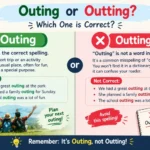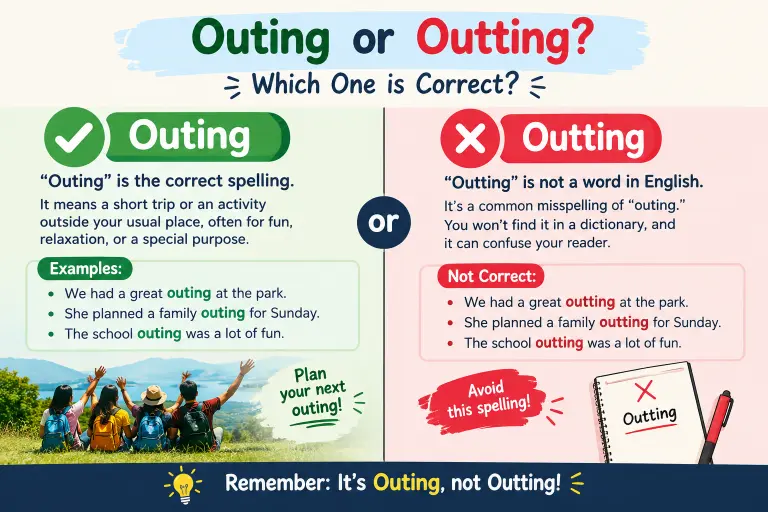
If you are unsure whether outing or outing is the correct spelling, the answer is simple: outing is the correct standard English spelling. “Outing” means a short trip or activity away from home, such as a family outing, school outing, or weekend outing. “Outting” is not the standard spelling of this word. In this guide, you will learn why “outing” is correct, how the word is formed, how to use it in sentences, and how to avoid this common spelling mistake.
Quick Answer
The correct spelling is outing, not outting.
Outing is a noun that usually means a short trip, visit, or activity outside the home. For example, you might go on a family outing to the park or enjoy a school outing with your classmates.
The word comes from the verb out plus the suffix -ing. When “-ing” is added to “out,” the spelling remains “outing. The final consonant is not doubled.
Here are two simple examples:
- We planned a family outing for Saturday.
- Our school outing was a lot of fun.
The spelling outing is a common mistake, but it is not the standard form used in modern English.
| Spelling | Correct? | Meaning |
| outing | Yes | A short trip or activity away from home |
| putting | No | Nonstandard spelling of “outing” |
If you are writing an email, school assignment, website, article, or professional message, use outing.
Meaning or Definition
The word outing usually refers to a short trip or an activity that people do outside their normal home or work setting.
For example, a group of friends may plan an outing to a restaurant. A family may have an outing at a zoo. A school may organize an outing to a museum.
The word can describe both the trip itself and the activity involved.
Consider these examples:
“Tomorrow, we are going on a family outing.”
Here, “outing” means a trip or activity that the family will enjoy together.
“Our class had an outing at the science museum.”
In this sentence, “outing” refers to a school trip.
“Let’s plan an outing this weekend.”
Here, “outing” means a planned activity outside the home.
The word is common in everyday American English. You will often see it used with words such as family, school, weekend, group, outdoor, class, and day.
Some common phrases include:
- family outing
- school outing
- weekend outing
- group outing
- outdoor outing
- fun outing
- day outing
- company outing
- class outing
Although “outing” often suggests a pleasant or social activity, the exact meaning depends on the sentence.
Grammar or Correct Usage
Outing is primarily used as a noun.
A noun is a word that names a person, place, thing, or idea. In this case, “outing” names a trip or activity.
For example:
“We had a wonderful outing.”
The word “outing” is the thing the sentence is talking about.
You can also use “outing” with an article such as an or the.
Examples:
- We planned an outing for Sunday.
- The outing lasted several hours.
- She enjoyed the outing with her friends.
- They are organizing an outing for the children.
Because “outing” begins with a vowel sound, we normally use an before it, not “a.”
Correct:
- We planned an outing.
Incorrect:
- We planned an outing.
You can also make the word plural:
- outing → outings
For example:
“Our summer outings are always enjoyable.”
The plural form simply adds -s because the word already ends in the normal “-ing” form.
| Form | Example |
| Singular | We planned an outing. |
| Plural | We planned several outings. |
| With an adjective | We had a fun outing. |
| With a possessive | The children’s outing was exciting. |
The important point is that the spelling stays the same.
Why Is “Outing” Correct?
The confusion between outing and outing often comes from a spelling pattern that English learners see in other words.
English sometimes doubles the final consonant when adding -ing.
For example:
- run → running
- sit → sitting
- swim → swimming
- stop → stopping
Because learners see these examples, they may assume that out should become putting.
However, that rule does not apply here.
The verb out is normally followed by -ing without doubling the final consonant:
out + ing = outing
So the correct spelling is:
outing
Not:
putting
This is an important reminder that English spelling rules depend on the structure and pronunciation of the original word.
You should not automatically double the final consonant every time you add -ing.
Outing vs. Outing
The main difference is spelling.
Outing is the standard English word. It has a clear meaning and is widely used in everyday writing.
Putting is generally a spelling error when someone intends to write “outing.”
For example:
Incorrect: “We are planning an outing this weekend.”
Correct: “We are planning an outing this weekend.”
Incorrect: “The school outing was canceled.”
Correct: “The school outing was canceled.”
Incorrect: “I enjoyed our family outing.”
Correct: “I enjoyed our family outing.”
The extra t is unnecessary.
| Word | Standard English? | Example |
| outing | Yes | We had a great outing. |
| outting | No | This is a misspelling of outing. |
If you are proofreading your writing and see “putting,” replace it with “outing” when you mean a trip or activity outside the home.
Why Do People Write “Outting”?
The spelling outing is easy to create because English has many words that double their final consonant before -ing.
For example:
- get → getting
- run → running
- sit → sitting
- plan → planning
A writer may see these patterns and assume:
out + ing → outting
But this is not how the word is spelled.
Another reason is pronunciation. When people say “outing” quickly, the sound can sometimes make the word feel as if it has a stronger t sound. This may lead to the incorrect spelling “outting.”
Typing habits can also cause mistakes. When someone writes quickly, adding an extra letter is easy, especially with short words.
The best way to avoid the error is to remember the word as one complete spelling:
OUTING
You do not need to think of it as “out + ting.”
Think of it as:
outing
That simple habit can make the correct spelling easier to remember.
The Spelling Rule Behind “Outing”
The spelling of outing becomes easier to understand when you look at common rules for adding -ing.
In many short verbs ending in a single consonant, the final consonant may be doubled before -ing when certain conditions are met.
For example:
- run → running
- hop → hopping
- sit → sitting
- stop → stopping
But out does not follow that pattern.
The final t in “out” is not doubled.
Therefore:
out + ing = outing
This is not:
out + ting = outting
It is useful to remember that English spelling has many patterns, but not every word follows the same pattern. Trying to apply one spelling rule to every word can create mistakes.
| Base word | -ing form | Correct? |
| out | outing | Yes |
| run | running | Yes |
| sit | sitting | Yes |
| stop | stopping | Yes |
| plan | planning | Yes |
The important difference is that out becomes outing, not “outting.”
Real-Life Examples of “Outing”
The word outing is useful in many everyday situations.
A family might say:
“We are going on a family outing tomorrow.”
A school teacher might write:
“The students enjoyed their school outing.”
A group of friends might say:
“Let’s have a weekend outing.”
A company might organize:
“The company arranged a team outing.”
Someone talking about free time might say:
“I need a fun outing after a busy week.”
These examples show how flexible the word can be.
Here are more natural examples:
“We went on an outing to the beach.”
“Her family planned an outing to the zoo.”
“The children were excited about their school outing.”
“Our weekend outing was canceled because of the rain.”
“They are planning a group outing for next month.”
“I had a relaxing outing with my friends.”
“The museum was the perfect place for our outing.”
Notice that the spelling remains in every sentence.
Common Mistakes With “Outing”
The most common mistake is adding an extra t.
Incorrect:
“We had a family outing.”
Correct:
“We had a family outing.”
Another mistake is using the wrong article.
Incorrect:
“We planned an outing.”
Correct:
“We planned an outing.”
This happens because “outing” begins with a vowel sound.
A third mistake is using the word when you actually mean another type of trip.
For example, “outing” usually suggests a relatively short trip or activity. If you are talking about a long vacation, “outing” may not be the best word.
For example:
“We went on a two-week vacation.”
This sounds more natural than:
“We went on a two-week outing.”
The best word depends on the situation.
| Common mistake | Better form |
| outting | outing |
| a outing | an outing |
| several outing | several outings |
| family outting | family outing |
| school outting | school outing |
Checking both spelling and grammar will make your sentence clearer.
Outing in American English
Outing is a normal and familiar word in American English.
People use it in casual conversations, school communication, workplace writing, travel discussions, and many other settings.
For example, an American speaker might say:
“We’re planning a family outing this weekend.”
A teacher might write:
“Please bring lunch for the class outing.”
A workplace message might say:
“Our team outing will be held on Friday.”
The spelling does not change in American English.
The standard form is:
outing
You may occasionally see “outting” online because people make spelling mistakes, but seeing a misspelling does not make it a standard English word.
When writing for school, work, business, or a website, choose outing.
British vs American English
There is no major British-American spelling difference between outing and outting.
Both American English and British English use outing as the standard spelling.
This is important because some English words have different spellings in the two varieties.
For example:
- American: color
- British: colour
And:
- American: center
- British: centre
But outing does not work this way.
Both varieties use:
outing
Therefore, you do not need to choose between an American spelling and a British spelling here.
| English variety | Correct spelling |
| American English | outing |
| British English | outing |
| Canadian English | outing |
| Australian English | outing |
The extra t is not a standard regional spelling.
Outing in Different Situations
“Outing” can be used in many situations, which is one reason it is a useful everyday word.
A family outing is a trip or activity enjoyed by family members.
Example:
“We had a family outing at the park.”
A school outing is an organized trip involving students.
Example:
“The class went on a school outing to the museum.”
A group outing is an activity involving several people.
Example:
“Our friends planned a group outing.”
A company outing is an activity organized for employees.
Example:
“The company arranged an outing for its staff.”
A weekend outing is a short activity or trip taken during the weekend.
Example:
“We are planning a weekend outing.”
The meaning stays connected to the idea of going somewhere or doing something outside your usual routine.
How to Remember the Correct Spelling
A simple memory trick can help.
Remember:
OUT + ING = OUTING
Do not add another T.
You can also connect the word with a familiar phrase:
family outing
school outing
weekend outing
group outing
If you remember one of these phrases, the correct spelling will become easier to recognize.
Another useful trick is to think:
“There is already a T in OUT. I don’t need another one.”
So:
OUTING ✓
OUTTING ✗
When you see the incorrect spelling, ask yourself whether the extra “t” is really needed. It is not.
Tips for Better Spelling
If you often confuse “outing” and “outting,” try writing the correct word several times.
For example:
“I am going on an outing.”
“Our family outing was fun.”
“The school outing starts at nine.”
“We planned a weekend outing.”
Reading the word in real sentences is often more useful than memorizing a spelling rule alone.
You can also check your writing before publishing it. This is especially important if you are writing:
- school assignments
- business emails
- blog posts
- website content
- social media posts
- invitations
- travel plans
A quick spelling check can catch the extra “t.”
Most importantly, do not let the incorrect spelling you see online influence your own writing. Internet users make spelling mistakes every day.
Standard writing should use outing.
FAQs
Is “outing” or “outting” correct?
Outing is correct. “Outting” is a common misspelling. Use “outing” when you mean a short trip or activity away from home.
What does “outing” mean?
“Outing” usually means a short trip, visit, or activity outside the home. Examples include a family outing, school outing, or weekend outing.
Why is “outting” wrong?
“Outting” incorrectly doubles the final t in “out.” The standard spelling is formed as out + ing = outing.
Is “outing” used in American English?
Yes. “Outing” is common and standard in American English. It is also used in British English and other varieties of English.
Is “outing” a noun or a verb?
“Outing” is commonly used as a noun when it means a trip or activity. For example, “We had a fun outing.” It can also appear as the -ing form of the verb “out” in contexts where that verb is used.
Should I write “a outing” or “an outing”?
Write an outing. The word begins with a vowel sound, so “an” is the correct article. For example, “We planned an outing for Saturday.”
Conclusion
When choosing between outing or outting, always use outing for standard English. The word refers to a short trip, visit, or activity outside the home, and it is common in phrases such as “family outing,” “school outing,” and “weekend outing.”
The extra t in “outting” is not needed. The correct spelling is simply out + ing = outing.
Remembering this small spelling point can help you write more clearly and confidently. If you are unsure, think of the familiar phrase “family outing.” You will quickly see that outing is the standard form.
Whether you are writing a school assignment, email, blog post, or casual message, choose outing. It is simple, correct, and widely understood in both American and British English.