English spelling can be confusing, especially when British and American English sometimes use different forms of the same word. For example, British writers often use colour, while American writers prefer color. These differences make it reasonable to wonder whether seperate or separate is correct in the UK.
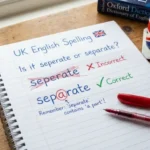
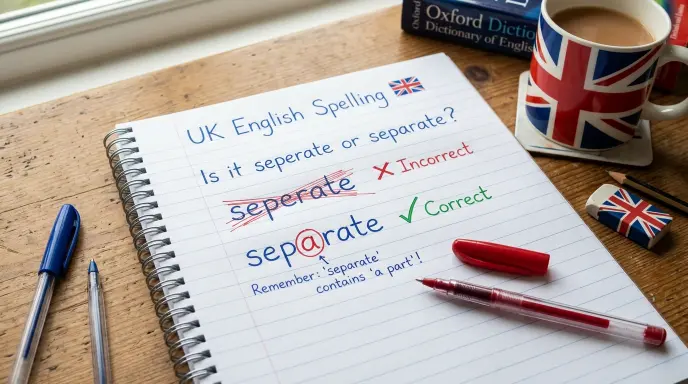
The answer is simple: separate is the correct spelling in British English and American English. The word seperate is a common spelling error, even though many people use it in emails, school assignments, and online writing.
In this article, you will learn the correct UK spelling, the meaning of separate, why people often misspell it, and how to remember the correct form. You will also discover useful synonyms, practical examples, common mistakes, and answers to frequently asked questions about this word.
What Does “Seperate or Separate UK” Mean?
The search phrase “seperate or separate UK” refers to a spelling question. People want to know which form is correct when writing in British English.
The correct answer is separate.
The word separate has several meanings depending on how you use it.
Separate as a verb
As a verb, separate means to divide something into different parts or move things apart.
Examples:
- Please separate the clean clothes from the dirty ones.
- The teacher asked the students to separate into two groups.
- We need to separate the facts from the opinions.
Separate as an adjective
As an adjective, separate means different, distinct, or not joined together.
Examples:
- We booked separate rooms for the trip.
- The company has two separate offices.
- Each student must submit a separate assignment.
Separate in British English
British writers use separate in the same way as American writers.
| British English | American English |
| Separate | Separate |
| Seperate | Seperate (incorrect) |
| Separately | Separately |
| Separation | Separation |
There is no UK-specific spelling change for this word.
Why Do People Search for Other Ways to Say “Seperate or Separate UK”?
People search for spelling alternatives because they want to write correctly and communicate clearly.
Understanding the correct spelling helps writers:
- Avoid spelling mistakes in schoolwork and professional documents.
- Improve the quality of emails and reports.
- Write naturally in British and American English.
- Choose more precise words for different situations.
- Avoid confusion when using similar words.
Sometimes, people also want synonyms for separate because using the same word repeatedly can make their writing sound dull.
For example:
“Please separate the documents and separate the receipts.”
A more natural version would be:
“Please divide the documents and organize the receipts.”
10 Best Other Ways to Say “Separate”
The following alternatives can help you express the meaning of separate more clearly. Each word has a slightly different meaning, so choose one that fits your sentence.
1. Divide
Meaning: To divide means to split something into parts or groups.
Best For: Professional, Formal, Casual
Example 1: Please divide the students into four teams.
Example 2: We divided the bill equally between everyone.
Quick Tip: Use divide when something is being split into smaller parts.
2. Distinguish
Meaning: To distinguish means to recognize or show how one thing differs from another.
Best For: Professional, Formal
Example 1: The report distinguishes facts from personal opinions.
Example 2: It is important to distinguish genuine products from imitations.
Quick Tip: Use distinguish when you want to highlight differences rather than physically move things apart.
3. Isolate
Meaning: To isolate means to keep something or someone apart from others.
Best For: Professional, Formal
Example 1: The researchers isolated the sample for further testing.
Example 2: The team isolated the problem to one faulty component.
Quick Tip: Use isolate when something needs to remain apart for a specific purpose.
4. Split
Meaning: Split means to divide something into two or more parts.
Best For: Casual, Friendly, Professional
Example 1: We decided to split the workload between two departments.
Example 2: They split the pizza into eight slices.
Quick Tip: Split often sounds more conversational than divide.
5. Detach
Meaning: Detach means to disconnect or remove something from what it is attached to.
Best For: Professional, Formal
Example 1: Please detach the receipt before submitting the form.
Example 2: The technician detached the damaged cable from the device.
Quick Tip: Use detach when something is physically connected to another object.
6. Disassociate
Meaning: Disassociate means to disconnect something from a particular person, idea, or connection.
Best For: Professional, Formal
Example 1: The organization wanted to disassociate itself from the misleading advertisement.
Example 2: Try to disassociate your personal feelings from the decision.
Quick Tip: Use disassociate for relationships, ideas, or affiliations.
7. Disengage
Meaning: Disengage means to release, disconnect, or withdraw from something.
Best For: Professional, Formal, Casual
Example 1: The driver disengaged the parking brake.
Example 2: She decided to disengage from the argument.
Quick Tip: Disengage often describes ending involvement or releasing a connection.
8. Partition
Meaning: Partition means to divide an area or object into distinct sections.
Best For: Professional, Formal
Example 1: The office was partitioned into several workspaces.
Example 2: We partitioned the storage area for different supplies.
Quick Tip: Use partition when you are creating clearly defined sections.
9. Segregate
Meaning: Segregate means to separate people or things into different groups.
Best For: Professional, Formal
Example 1: The laboratory segregates hazardous waste from regular waste.
Example 2: The system segregates customer information by account type.
Quick Tip: Use segregate carefully when discussing people because it can carry historical and social meaning.
10. Set Apart
Meaning: Set apart means to make something distinct or different from others.
Best For: Friendly, Warm, Professional
Example 1: Her attention to detail sets her apart from other candidates.
Example 2: The building’s unusual design sets it apart from nearby homes.
Quick Tip: Use set apart when describing something that stands out rather than something physically divided.
Comparison Table
| Alternative | Best Used In | Tone |
| Divide | Groups, tasks, quantities | Neutral |
| Distinguish | Differences, facts, ideas | Formal |
| Isolate | Research, problems, objects | Professional |
| Split | Bills, tasks, groups | Casual |
| Detach | Connected objects | Technical |
| Disassociate | Relationships, affiliations | Formal |
| Disengage | Connections, involvement | Neutral |
| Partition | Spaces, sections | Formal |
| Segregate | Categories, materials | Formal |
| Set apart | Qualities, achievements | Positive |
Common Mistakes
Even experienced writers sometimes misspell separate. Here are five mistakes to watch for when writing in British or American English.
1. Writing “Seperate” Instead of “Separate”
This is the most common mistake. Many people write seperate because they hear a sound that resembles the letter “e” in the middle of the word.
Incorrect: Please seperate the files by date.
Correct: Please separate the files by date.
2. Assuming British English Uses “Seperate”
Some writers believe British English has a different spelling from American English.
However, both varieties use separate. The spelling does not change based on the country.
3. Confusing “Separate” With “Separately”
Separate can function as a verb or adjective, while separately is an adverb.
Incorrect: Please handle the two projects separate.
Correct: Please handle the two projects separately.
4. Using the Wrong Word in Formal Writing
Some synonyms do not fit every situation.
For example, isolate may suggest keeping something alone, while divide means splitting something into parts. Choosing the wrong word can change the meaning of your sentence.
5. Forgetting to Check Related Words
Words such as separation, separately, and separating also contain the same spelling pattern.
Remembering the correct spelling of the base word helps you spell its related forms correctly.
Frequently Asked Questions
1. Is “seperate” or “separate” correct in UK English?
Separate is the correct spelling in UK English. The spelling seperate is a common error and does not appear as a standard alternative in British English. You should use separate in school assignments, professional emails, reports, and everyday writing.
2. Is “separate” British or American English?
Separate is used in both British and American English. Unlike words such as colour and color, it does not have different standard spellings in these varieties. Writers in the UK and USA can use separate without changing its spelling to match their country’s English style.
3. Why is “seperate” commonly misspelled?
People often misspell separate because the pronunciation can make the middle vowel sound unclear. They may also confuse it with familiar spelling patterns in other English words. Since the incorrect form looks reasonable, writers sometimes repeat the mistake without noticing it.
4. How do you pronounce “separate” in British English?
Separate has different pronunciations depending on whether you use it as a verb or adjective. As an adjective, it is commonly pronounced with three syllables, with the final syllable sounding like “rit.” As a verb, the final syllable sounds like “rate.” Both forms use the same spelling.
5. What is the difference between “separate” and “seperately”?
Separate is a verb or adjective, while separately is an adverb. For example, “Keep the files separate” uses separate as an adjective. “Please send the files separately” uses separately to describe how someone should send them. Both words contain the letter “a” in the middle.
6. What is the past tense of “separate”?
The past tense of separate is separated. For example, “We separated the documents yesterday.” The word follows the regular English pattern of adding “-ed” to form the past tense. Its spelling does not change to seperated in British or American English.
7. What are some synonyms for “separate”?
Common synonyms for separate include divide, split, distinguish, isolate, detach, partition, and segregate. The best choice depends on the meaning of your sentence. Divide and split often describe breaking something into parts, while distinguish describes recognizing differences between things.
8. How can I remember the correct spelling of “separate”?
A simple spelling trick is to remember that separate contains “par” in the middle. You can also break it into smaller parts: sep-a-rate. Another useful method is to write the word several times and use it in a sentence. Regular practice helps reinforce the correct spelling.
Conclusion
The correct spelling in British English is separate, not seperate. Both British and American English use the same spelling, so you do not need to change the word when writing for readers in the UK or USA.
Separate can work as a verb or adjective, depending on the sentence. It can describe dividing objects, keeping things apart, or showing how two things differ. If you want to make your writing more varied, you can also use words such as divide, distinguish, isolate, split, or detach.
The most important thing is to choose a word that fits your intended meaning. A synonym may sound more natural in one situation but change the meaning in another.
Helpful takeaway: Remember that separate contains the letters “par” in the middle. Whenever you are unsure, check the spelling before publishing your work.