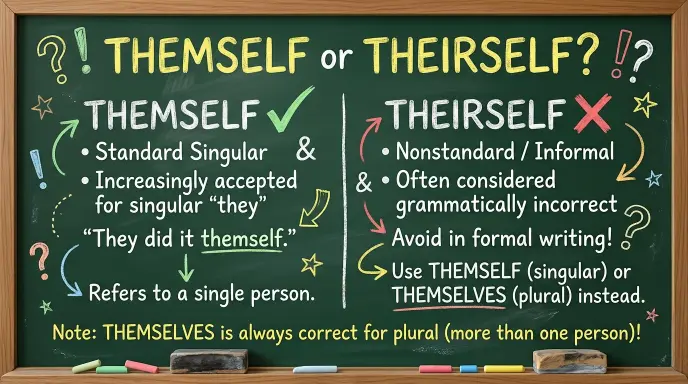
Choosing between themself and theirself can be confusing, especially because both forms appear in everyday conversations. They look similar, sound similar, and express nearly the same idea. However, they do not have the same level of acceptance in standard American English.
The main difference comes down to grammar, usage, and writing style. Themself is the more widely accepted reflexive pronoun for singular they, while theirself is more common in certain dialects and informal speech.
Understanding this difference can help you write clearer emails, school assignments, articles, and professional documents. It can also help you use gender-neutral language correctly when referring to one person.
In this guide, you will learn what each word means, when to use it, common mistakes to avoid, and how to choose the right form for different situations.
What Does “Themself or Theirself” Mean?
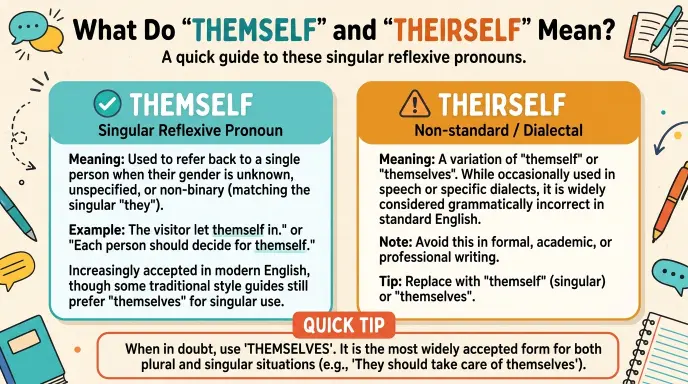
Themself and theirself are reflexive pronouns. A reflexive pronoun refers back to the person or subject performing an action.
For example:
- Jordan taught themself how to play guitar.
- Jordan taught theirself how to play guitar.
Both sentences communicate that Jordan learned the skill without someone else teaching them.
What Does Themself Mean?
Themself is a reflexive pronoun used with singular they. It refers to one person rather than a group.
For example:
“Alex prepared themself for the interview.”
In this sentence, themself refers to Alex, a single person. The word works naturally when someone uses they/them pronouns or when the person’s gender is unknown.
What Does Theirself Mean?
Theirself is another reflexive form associated with singular they. It appears in some regional varieties of English, informal conversations, and traditional dialects.
For example:
“Taylor wanted to prove theirself to the team.”
Although people may use this form in conversation, many standard American English style guides recommend themself instead.
Why Use Other Ways to Say “Themself or Theirself”?
Choosing the right reflexive pronoun helps your writing sound natural and grammatically clear.
Here are a few reasons to understand the alternatives:
- Improve grammar: Choose a form that fits standard American English.
- Avoid repetition: Use a person’s name when a pronoun appears too often.
- Sound professional: Follow accepted usage in formal documents.
- Respect identity: Use the pronouns a person prefers.
- Improve readability: Make sentences easier to understand.
10 Best Other Ways to Say “Themself or Theirself”
The following alternatives can help you express the same idea in different situations. Some are direct reflexive pronouns, while others are sentence-level replacements that make your writing clearer.
1. Themselves
Meaning
Themselves is the traditional plural reflexive pronoun. It is also commonly used with singular they in modern English, although some writers prefer themself when referring to one person.
Best For
- Professional
- Formal
- Casual
Example 1
Each applicant should introduce themselves before the interview begins.
Example 2
Someone left their notebook behind, so they should come and collect it themselves.
Quick Tip
Use themselves when following a style guide that prefers the traditional reflexive form for singular they.
2. Themself
Meaning
Themself refers to one person who uses singular they. It is the preferred choice when you want a reflexive pronoun that clearly matches a singular subject.
Best For
- Professional
- Formal
- Friendly
Example 1
Morgan reminded themself to submit the application before Friday.
Example 2
The new employee introduced themself to everyone in the office.
Quick Tip
Choose themself when referring to one person and you want to avoid confusion about whether the subject is singular or plural.
3. Himself or Herself
Meaning
Himself and herself are gender-specific reflexive pronouns. They refer to a male or female person, respectively, and can replace singular they when the person’s pronouns are known.
Best For
- Formal
- Professional
- Traditional writing
Example 1
Michael prepared himself for the final presentation.
Example 2
Sarah taught herself how to use the new software.
Quick Tip
Use these forms only when they match the person’s pronouns. Do not assume someone’s gender based on their name.
4. Oneself
Meaning
Oneself is a formal, general reflexive pronoun. It refers to an unspecified person rather than a particular individual.
Best For
- Formal
- Professional
Example 1
One must remind oneself to remain patient during difficult situations.
Example 2
A person should allow oneself enough time to learn a new skill.
Quick Tip
Use oneself for general statements rather than referring to a specific person who uses singular they.
5. The Person
Meaning
The person replaces a reflexive pronoun with a clear noun phrase. This can make a sentence easier to follow, especially when several pronouns appear together.
Best For
- Professional
- Formal
- Polite
Example 1
The person should review the instructions before submitting the form.
Example 2
The person can contact the manager if additional help is needed.
Quick Tip
Use this alternative when repeating a pronoun could make your sentence confusing.
6. That Individual
Meaning
That individual refers to a specific person without identifying their gender. It sounds more formal than the person and often appears in official or professional writing.
Best For
- Formal
- Professional
Example 1
That individual should complete the required training before starting work.
Example 2
The committee asked that individual to explain the decision.
Quick Tip
Use that individual sparingly. In everyday writing, the person often sounds more natural.
7. Themselves Personally
Meaning
Themselves personally adds emphasis to the person performing an action. However, it can sound repetitive because themselves already points back to the subject.
Best For
- Casual
- Friendly
Example 1
They should check the details themselves before making a decision.
Example 2
The students can speak to the teacher themselves if they have questions.
Quick Tip
In most sentences, themselves alone is enough. Add personally only when you need extra emphasis.
8. Without Help
Meaning
Without help describes an action completed independently. It replaces the idea of doing something by oneself without using a reflexive pronoun.
Best For
- Professional
- Casual
- Friendly
Example 1
Riley completed the entire project without help.
Example 2
The new student learned to navigate the campus without help.
Quick Tip
Use this phrase when independence is the main point of your sentence.
9. Independently
Meaning
Independently means doing something without relying on another person. It is useful in professional, educational, and workplace settings.
Best For
- Professional
- Formal
Example 1
The employee completed the assignment independently.
Example 2
The researcher conducted the initial review independently.
Quick Tip
Choose independently when describing skills, responsibilities, or work performance.
10. On Their Own
Meaning
On their own describes a person completing an action without assistance. It is a natural and widely used alternative in American English.
Best For
- Casual
- Friendly
- Professional
Example 1
Casey learned to cook on their own.
Example 2
The applicant completed the online assessment on their own.
Quick Tip
Use on their own when you want a conversational alternative that sounds natural in both speech and writing.
Comparison Table
Use this table to quickly compare the alternatives and choose the right expression for your sentence.
| Alternative | Best Used In | Tone |
|---|---|---|
| Themselves | Emails, articles, general writing | Neutral |
| Themself | Singular they, modern writing | Neutral |
| Himself or Herself | When pronouns are known | Formal |
| Oneself | General statements | Formal |
| The Person | Clear, direct writing | Neutral |
| That Individual | Official documents | Formal |
| Themselves Personally | Emphasis | Casual |
| Without Help | Describing independence | Neutral |
| Independently | Workplace, academic writing | Professional |
| On Their Own | Everyday conversation | Friendly |
Common Mistakes
Understanding the difference between themself and theirself can help you avoid common grammar problems.
1. Using Theirself in Formal Writing
Theirself appears in some dialects, but many editors consider it nonstandard in formal American English.
Better: The applicant should prepare themself for the interview.
2. Assuming Themself Is Incorrect
Some writers believe themself is not a real word because it does not follow the traditional plural form themselves.
However, major dictionaries recognize themself, and its use has become increasingly common with singular they.
3. Using Themselves Without Considering Context
Themselves can refer to a group or one person. If your sentence focuses on one individual, themself may make the meaning clearer.
Better: Each student should introduce themself.
4. Using Gender-Specific Pronouns Without Confirmation
Do not replace themself with himself or herself unless you know the person’s pronouns.
Better: Ask which pronouns the person uses, or keep the gender-neutral form.
5. Repeating Reflexive Pronouns Too Often
Repeated pronouns can make writing sound awkward.
Better: Instead of writing “Jordan reminded themself that they could do it themself,” try “Jordan remembered they could complete the task independently.”
Frequently Asked Questions
1. Is themself a real word?
Yes, themself is a recognized English word. Major dictionaries include it as a reflexive pronoun used with singular they. Although some people still prefer themselves, themself is widely accepted in modern American English, especially when referring to one person.
2. Is themself or theirself grammatically correct?
Themself is generally the preferred form in standard American English when referring to one person using singular they. Theirself appears in regional and informal speech, but many formal writing guides recommend avoiding it. The best choice depends on your audience and the style guide you follow.
3. What is the difference between themself and themselves?
Themself usually refers to one person, while themselves traditionally refers to more than one person. However, themselves is also widely used with singular they. Both forms are accepted in modern English, although some writers use themself to make singular meaning clearer.
4. Can I use themself in formal writing?
Yes. Themself is appropriate in many forms of formal writing, including professional emails, academic work, and articles. It is especially useful when referring to a person whose pronouns include they. However, check your organization’s or publication’s style guide because some editors prefer themselves.
5. Why do people use themself instead of themselves?
People use themself to show that they are referring to one person rather than a group. It can also help maintain clear pronoun agreement with singular they. The form is useful in inclusive language and is increasingly accepted in professional and everyday writing.
6. Is theirself ever correct?
Theirself is used in some regional dialects and informal conversations. It may be appropriate when writing dialogue that reflects a person’s natural speech. However, it is generally less accepted than themself in standard American English, so writers should use it carefully.
7. Should I use themself or himself or herself?
Use themself when referring to someone who uses singular they or when the person’s gender is unknown. Use himself or herself when you know the person’s pronouns and those forms match. Respecting a person’s preferred pronouns is more important than choosing a form based only on traditional grammar.
8. What is an example of themself in a sentence?
Here is a simple example: “Jamie reminded themself to bring the documents to the meeting.” The sentence refers to one person, Jamie, who uses singular they. The reflexive pronoun themself points back to the subject and shows that Jamie performed the action.
Conclusion
Choosing between themself and theirself becomes easier when you understand how each form works. Both expressions refer to a person performing an action on themselves, but they differ in their acceptance in standard American English.
For most modern writing, themself is the preferred choice when referring to one person who uses singular they. It works well in professional emails, articles, school assignments, and everyday communication. Theirself may appear in regional speech or informal conversations, but it is usually best to avoid it in formal writing.
You can also use alternatives such as themselves, independently, or on their own when they fit your sentence naturally. These expressions help you avoid repetition and improve clarity.
The most helpful rule is simple: choose the form that matches the person, the context, and your audience. When in doubt, use themself for singular they and follow your preferred style guide.