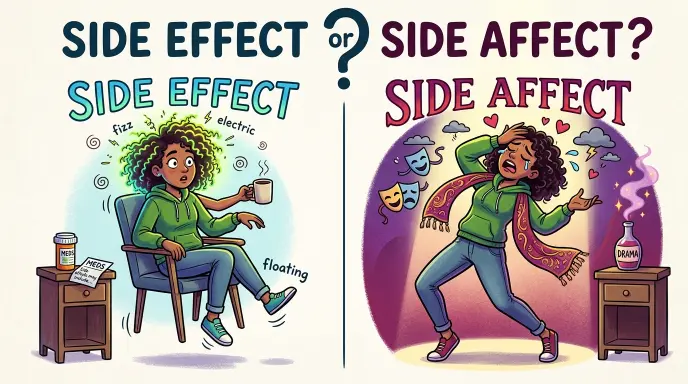
Have you ever wondered whether to write “side effect” or “side affect”? These expressions look similar, but they do not have the same meaning or grammatical role. “Side effect” is the correct phrase when you mean an extra or unintended result, especially from a medicine or treatment. “Side affect” is usually incorrect for this meaning. The word affect is most often a verb that means to influence something.
Understanding the difference between side effect and affect can help you write better emails, school assignments, blog posts, and everyday messages. It can also help you understand health information more clearly. In this guide, you will learn what each term means, when to use it, how to avoid common spelling mistakes, and how to use both words in real sentences. The examples are simple, practical, and easy to remember.
Quick Answer: Side Effect or Affect?
The correct choice depends on what you want to say.
- Side effect: An extra result of an action, medicine, or treatment that is not the main intended result.
- Affect: A verb that usually means to influence, change, or have an impact on something.
- Side affect: Usually a spelling mistake when you mean an unintended result of medicine or another action.
For example, “This medicine may cause a side effect” is correct. “The medicine may affect your sleep” is also correct, but it has a different meaning.
The easiest way to remember the difference is this: a side effect is a result, while affect describes an action or influence. Both expressions are useful, but you cannot replace one with the other in every sentence.
Meaning of Side Effect
A side effect is an additional result of something, especially a medicine, medical treatment, or action. It is not usually the main result that a person wants or expects.
The phrase is most often used in health care. For example, a medicine may help relieve a headache but also cause an upset stomach. The upset stomach is a possible side effect.
However, the phrase is not limited to medicine. It can also describe an unexpected result of a decision, plan, or activity.
Consider these examples:
- A possible side effect of the medicine is feeling sleepy.
- One side effect of working late is getting less sleep.
- A side effect of the new school rule was longer lunch lines.
- One side effect of using a phone at night may be losing sleep time.
In each sentence, side effect refers to a result that happens in addition to the main purpose or expected outcome.
The phrase contains two words: side and effect. Here, side suggests something additional, while effect means a result or change caused by something.
Remember that a side effect is not always harmful. In medical use, it often refers to an unwanted or unpleasant reaction, but additional effects in other situations can be helpful, neutral, or harmful.
Meaning of Affect
Affect is usually a verb. It means to influence something or cause a change in a person, situation, feeling, or result.
When something affects you, it has an impact on you in some way.
For example, rain can affect travel plans. A lack of sleep can affect your mood. A change in school hours can affect students and their families.
Here are more examples:
- Cold weather can affect your skin.
- Stress may affect how well you sleep.
- The new rule will affect all students.
- Loud noise can affect your ability to concentrate.
- A price increase may affect family spending.
In these sentences, affect describes what one thing does to another thing.
It does not name an additional result in the way that side effect does. Instead, it shows that something influences or changes something else.
You may also see affect used as a noun in psychology, where it refers to the way someone shows emotion. This is a specialized use, so beginners can usually focus on its common verb meaning.
Side Effect or Affect: Main Differences
Although the words look similar, they serve different purposes in a sentence. The most important difference is that side effect is a noun phrase, while affect is usually a verb.
| Feature | Side effect | Affect |
|---|---|---|
| Part of speech | Noun phrase | Usually a verb |
| Main meaning | An additional result | To influence or change |
| Common use | Medicine, treatment, actions, decisions | Feelings, plans, health, weather, results |
| Example | The medicine caused a side effect. | The medicine may affect your sleep. |
| Easy question | What result happened? | What does it influence? |
Look at these two sentences:
“The medicine caused a side effect.”
“The medicine may affect your sleep.”
The first sentence names an additional result. The second sentence explains how the medicine might influence sleep.
Both sentences can be correct at the same time. A medicine might have a side effect that affects your sleep, for example.
Here is another comparison:
| Incorrect or less suitable sentence | Correct sentence | Reason |
|---|---|---|
| The drug caused a side affect. | The drug caused a side effect. | Use effect in the noun phrase. |
| Bad weather may side effect our plans. | Bad weather may affect our plans. | Use affect as the verb. |
| Lack of sleep can side affect your mood. | Lack of sleep can affect your mood. | The sentence needs a verb. |
| The side affect was unexpected. | The side effect was unexpected. | Side effect is the standard phrase. |
These examples show why spelling alone is not enough. You must also choose the word that fits the meaning and grammar of your sentence.
Why Is Side Effect Correct Instead of Side Affect?
The standard expression is side effect, not side affect. This is because effect is a noun meaning a result or outcome.
When you talk about an extra result of medicine, a treatment, or an action, you need a noun. That is why effect is the correct word in this phrase.
For example:
“The new medicine had an unexpected side effect.”
The word effect names the additional result. The word side helps describe the type of result.
Writing “The new medicine had an unexpected side affect” is not standard English for this meaning.
The confusion is understandable because affect and effect sound alike in many varieties of American English. Their spellings differ by only one letter, and both words relate to change or influence.
However, they usually play different roles in a sentence. Affect commonly describes an action, while effect commonly names a result.
You do not need to memorize a long grammar rule to understand the phrase. Simply remember that the established expression is side effect. If you are describing an additional result, use this two-word phrase.
How to Use Side Effect in a Sentence
Use side effect when you want to name an additional outcome. The phrase often appears with verbs such as cause, have, experience, and develop.
For example, you can say that a person experiences a side effect or that a treatment may cause a side effect.
Here are examples from different situations.
Medical examples
- The doctor explained the possible side effects of the treatment.
- Drowsiness is a possible side effect of some medicines.
- The patient reported a side effect after starting the new medicine.
- Ask your pharmacist about possible side effects before using a medicine.
These examples describe possible or reported health effects. A symptom occurring after someone takes a medicine does not automatically prove that the medicine caused it.
Everyday life examples
- One side effect of staying up late is feeling tired the next morning.
- A side effect of the busy schedule was having less time for family.
- The new traffic plan had an unexpected side effect.
- One side effect of the move was a longer trip to work.
School and work examples
- One side effect of the new timetable was a shorter break.
- The office change had a positive side effect: better teamwork.
- A side effect of the extra homework was less free time.
- The new software had an unexpected side effect on the team’s workflow.
Notice that side effect works as a noun phrase in every example. You can place it after words such as a, the, possible, unexpected, or unwanted.
You can also use the plural form, side effects, when talking about more than one result.
How to Use Affect in a Sentence
Use affect when you mean that something influences or changes another thing. In most everyday sentences, it acts as the main verb.
For example:
“Too much noise can affect your concentration.”
In this sentence, noise is the subject, affect is the verb, and your concentration is what receives the influence.
Here are more examples:
- Heavy rain may affect tomorrow’s game.
- Your choices can affect your future.
- A poor night’s sleep can affect your mood.
- The price change will affect many customers.
- A new school policy may affect students and teachers.
- Personal stress can affect the way you work.
- Changes in traffic can affect your arrival time.
The verb can also appear in different forms, depending on the sentence.
| Form | Example |
|---|---|
| Affect | Noise can affect my sleep. |
| Affects | Noise affects my sleep. |
| Affected | The storm affected our travel plans. |
| Affecting | The delay is affecting our schedule. |
| Will affect | The new rule will affect everyone. |
The form affects is used with a singular subject in the simple present tense, such as “The weather affects travel.”
Use affect with subjects such as I, you, we, and they in the simple present, as in “These changes affect everyone.”
If you are unsure which form to use, check the subject and the tense. The main meaning stays the same: to influence or make a difference to something.
Side Effect vs. Effect vs. Affect
Another reason people confuse side effect and affect is that the word effect can also appear on its own.
In standard everyday English, effect is usually a noun meaning a result. Affect is usually a verb meaning to influence. The phrase side effect uses the noun effect.
Compare the following sentences:
- “The rain affected our plans.” Here, affected means influenced.
- “The rain had an effect on our plans.” Here, effect means result or impact.
- “The rain had a side effect on our plans.” This sentence is less natural if you simply mean that the rain changed the plans. Use effect unless you specifically mean an additional result.
A side effect is a particular kind of effect, but not every effect is a side effect.
For example, if a medicine is taken to relieve pain, pain relief is the intended effect. Feeling sleepy afterward may be a side effect if it is an additional, unintended reaction associated with the medicine.
This distinction is useful in health writing, schoolwork, and daily communication.
Common Mistakes When Writing Side Effect or Affect
Even confident English speakers sometimes mix up these words. Most errors happen because the words sound similar or because the writer does not check the role a word plays in a sentence.
Here are common mistakes and ways to avoid them.
Mistake 1: Writing “side affect” instead of “side effect.”
Incorrect: The doctor discussed the side affect of the medicine.
Correct: The doctor discussed the side effect of the medicine.
Why? The sentence names a result, so the standard phrase uses the noun effect.
Mistake 2: Using “side effect” as a verb.
Incorrect: The weather may side effect our plans.
Correct: The weather may affect our plans.
Why? In this sentence, you need a verb that means influence. Affect fits that role.
Mistake 3: Using “affect” when you mean a result.
Incorrect: The main affect of the decision was a shorter workday.
Correct: The main effect of the decision was a shorter workday.
Why? The sentence identifies a result, so effect is the correct choice.
Mistake 4: Assuming every effect is a side effect.
Incorrect: The medicine’s main benefit was a side effect.
Better: The medicine’s main benefit was its intended effect.
Why? The main purpose of a medicine is not normally called a side effect. A side effect refers to an additional effect, often one that is not intended.
Mistake 5: Treating every symptom after taking medicine as a proven side effect.
A person may notice a symptom after taking a medicine, but timing alone does not prove the medicine caused it. Other factors may be involved. For medical concerns, ask a qualified health professional.
A simple proofreading habit can prevent many writing errors. Read your sentence and ask whether you are describing an action or naming a result. If you are naming an additional result, side effect may be the right choice. If you mean influence, use the appropriate form of affect.
Side Effect or Affect in American English
In American English, side effect is the standard spelling for an additional result, especially one linked to a medicine or treatment. Affect is commonly used as a verb meaning to influence something.
These uses are not special American-only rules. They are also standard in British English and other major varieties of English.
For example, an American writer might say, “The medicine caused a side effect.” A British writer can use the same expression with the same meaning.
Likewise, “The weather affected our plans” is correct in both American and British English.
Some other words have different spellings across these varieties, such as color and colour. However, the distinction between affect and effect is generally the same.
If you write for a United States audience, use side effect for the noun phrase and affect when you mean to influence. You do not need a different spelling rule for American English.
Side Effect or Affect in Health and Medical Writing
The phrase side effect is especially important in health information because it can describe an unwanted response associated with a medicine or treatment.
For example, a medicine may be used to treat a condition, but it may also cause other reactions. Depending on the medicine, the person, and the situation, these reactions may be mild, serious, temporary, or long-lasting.
The phrase affect is useful when explaining how a health condition, medicine, or lifestyle choice may influence the body or daily life.
Consider these examples:
- A medicine may have a side effect that causes drowsiness.
- The medicine may affect a person’s ability to drive safely.
- Poor sleep can affect attention and mood.
- A treatment may have side effects that require medical advice.
These sentences use the words in different ways. The first names an additional reaction. The second explains a possible influence on safety.
Medical writing also requires care with certainty. Words such as may, can, and possible help show that an outcome does not happen to everyone. Never assume that a medicine will produce the same effects in every person.
If you experience a new or concerning symptom after starting a medicine, contact a health professional for advice. Seek urgent medical help for signs of a severe reaction, such as trouble breathing or swelling of the throat. Do not stop or change a prescribed treatment without appropriate medical guidance unless emergency instructions tell you otherwise.
Clear wording helps readers understand medical information, but accurate advice matters just as much as correct spelling.
Easy Tricks to Remember the Difference
You can remember the difference between side effect and affect with a few simple techniques.
Trick 1: Remember the phrase as a whole.
Learn side effect as one fixed expression. Do not try to choose between affect and effect every time you write it. The correct spelling is always side effect when you mean an additional result.
Trick 2: Think of action and result.
Use affect for the action of influencing something.
Example: “Lack of sleep can affect your mood.”
Use effect for a result.
Example: “Lack of sleep can have an effect on your mood.”
Use side effect for an additional result.
Example: “One side effect of the busy schedule was less sleep.”
Trick 3: Replace the word with a simpler phrase.
If you can replace affect with “influence,” you probably need the verb.
“The new rule may affect students.”
“The new rule may influence students.”
Both sentences make sense.
If you can replace effect with “result,” you probably need the noun.
“The effect of the change was clear.”
“The result of the change was clear.”
Both sentences work.
Trick 4: Check what comes after the word.
In the sentence “Stress can affect your sleep,” the phrase your sleep tells you what is being influenced.
In “Stress can have an effect on your sleep,” the noun effect is used with the article an and the phrase on your sleep.
These patterns are useful clues, although they are not rules that cover every possible use of the words.
Trick 5: Practice with short sentences.
Write one sentence with affect and another with side effect. For example, “The weather affected our trip” and “One side effect of the trip was feeling tired.”
Practicing the words in context makes the difference easier to remember than memorizing definitions alone.
Frequently Asked Questions About Side Effect or Affect
1. Is it side effect or side affect?
The correct phrase is side effect. It means an additional result of something, especially a medicine or treatment. “Side affect” is usually a spelling mistake when used with this meaning.
2. What does side effect mean in simple words?
A side effect is an extra result that happens along with the main result. For example, a medicine may help with pain but also cause drowsiness. Drowsiness may be a side effect of that medicine.
3. What does affect mean in a sentence?
Affect usually means to influence or change something. For example, “Heavy rain can affect travel plans.” This means heavy rain can influence or change those plans.
4. What is the difference between affect and effect?
Affect is usually a verb meaning to influence. Effect is usually a noun meaning a result. For example, “The noise affected my sleep” uses a verb, while “The noise had an effect on my sleep” uses a noun.
5. Can I use side effect for something other than medicine?
Yes. You can use side effect to describe an additional result of an action, decision, or situation. For example, “One side effect of working late was having less time to relax.” The phrase is especially common in medical contexts, but it is not limited to them.
6. How can I remember whether to use side effect or affect?
Remember that side effect names an additional result, while affect usually describes an influence. If you can replace affect with “influence,” the verb is probably correct. If you mean an extra result, write side effect.
Conclusion
Choosing between side effect or affect becomes easy once you understand how each expression works. Side effect is the correct phrase when you mean an additional result, such as an unwanted reaction to a medicine. Affect is usually a verb that means to influence or change something.
For example, “The medicine caused a side effect” names a result, while “The medicine may affect your sleep” describes a possible influence. Both sentences are correct because they express different ideas.
When writing, ask yourself whether you are naming a result or describing an action. If you mean an extra result, use side effect. If you mean to influence something, use affect.
Remembering this simple difference will help you avoid common spelling mistakes and write clearer English in schoolwork, blog posts, emails, and everyday conversations. A little practice with real sentences will make the correct choice feel natural.