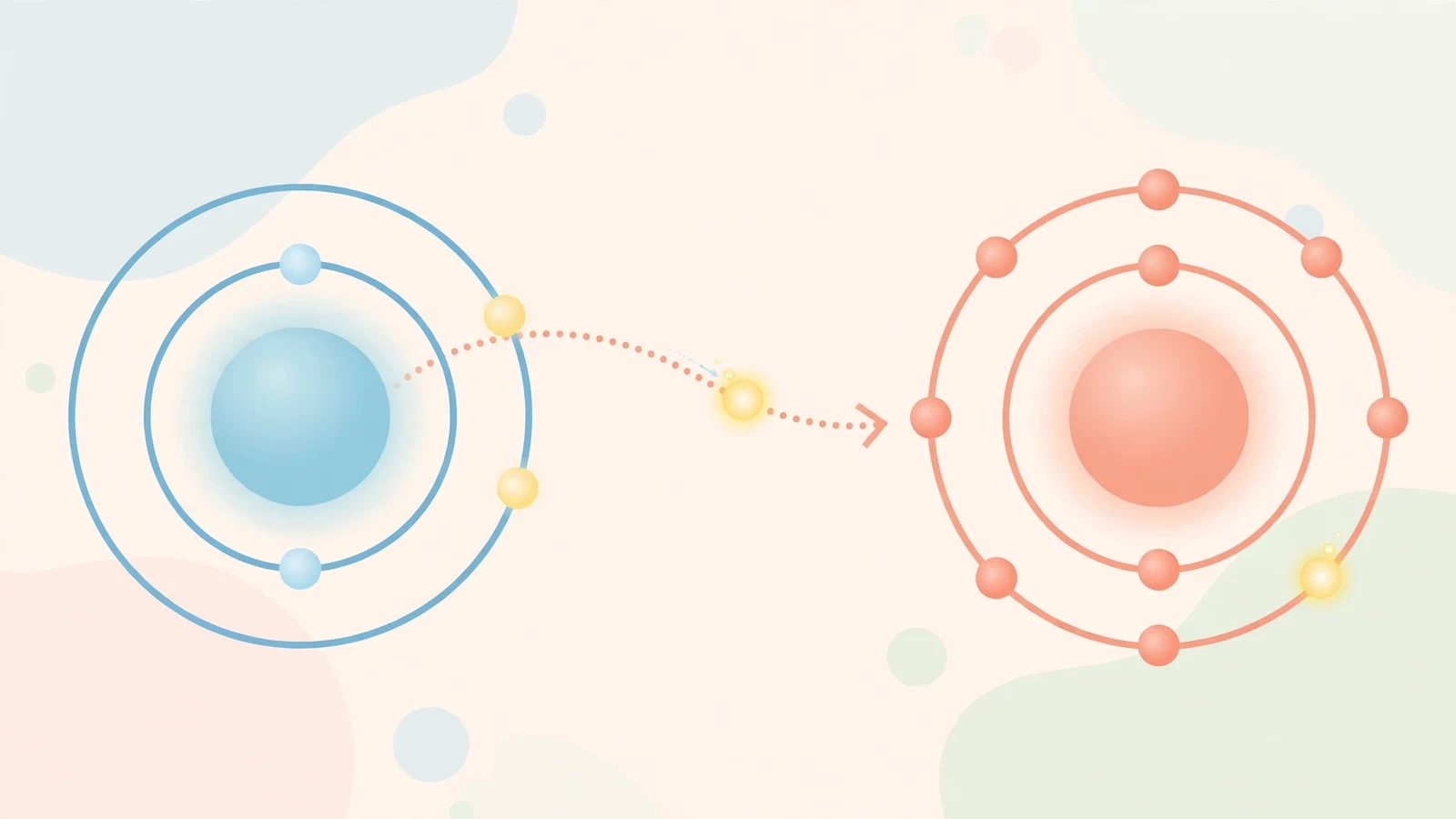
Students meet magnesium oxide, written as MgO, very early in chemistry. It looks simple: two letters, one compound. Yet the question “Is MgO ionic or covalent?” causes real confusion, because MgO does not behave like the familiar covalent molecules students know, such as water or carbon dioxide. The short answer is clear: MgO is an ionic compound. This article explains why, in plain language, and shows how you can classify similar compounds on your own.
You will learn what ionic and covalent bonds are, how magnesium and oxygen combine, what properties prove that MgO is ionic, and which mistakes to avoid in exams. By the end, MgO will no longer be a guessing game.
What Is an Ionic Bond?
An ionic bond forms when one atom gives electrons to another atom. The atom that loses electrons becomes positively charged, and chemists call it a cation. The atom that gains electrons becomes negatively charged, and chemists call it an anion. Opposite charges attract, just as opposite ends of a magnet attract, and that strong attraction holds the two ions together.
Ionic bonds usually form between a metal and a nonmetal. Metals tend to lose electrons easily, while nonmetals tend to gain them. The result is not a single small molecule but a large, regular arrangement of ions, called a crystal lattice. Table salt, sodium chloride (NaCl), is the most famous example: sodium loses one electron, chlorine gains one, and the ions pack together into crystals.
Ionic compounds share a set of typical properties. They usually have high melting and boiling points, because a lot of energy is needed to pull the ions apart. They are usually solid at room temperature. They often dissolve in water, and when they do, the solution can conduct electricity because the ions are free to move.
What Is a Covalent Bond?
A covalent bond forms when two atoms share electrons instead of giving them away. Sharing lets both atoms fill their outer electron shells and reach a stable state, similar to a noble gas. Covalent bonds usually form between two nonmetals, because neither atom is keen to give up electrons completely.
Water (H2O) is a classic covalent compound. Each hydrogen atom shares electrons with oxygen. Carbon dioxide (CO2) is another example: carbon shares electrons with two oxygen atoms. Covalent compounds often form separate small molecules rather than giant lattices. As a result, many of them have lower melting and boiling points than ionic compounds, and many do not conduct electricity when dissolved in water.
There are two kinds of covalent bonds. In a nonpolar covalent bond, electrons are shared fairly equally, as in oxygen gas (O2). In a polar covalent bond, one atom pulls the shared electrons more strongly, so the molecule has a slightly positive end and a slightly negative end. Water is polar covalent for exactly this reason.
So, Is MgO Ionic or Covalent?
MgO is ionic. Magnesium (Mg) is a metal, and oxygen (O) is a nonmetal, which already points strongly toward an ionic bond. The details confirm it.
A magnesium atom has two electrons in its outer shell. It loses both of them and becomes Mg2+, a positively charged ion with the stable electron arrangement of neon. An oxygen atom has six electrons in its outer shell and needs two more to complete it. It gains the two electrons from magnesium and becomes O2-, a negatively charged ion, also with the electron arrangement of neon.
The Mg2+ and O2- ions then attract each other strongly. They do not stay as one small MgO molecule floating alone. Instead, huge numbers of magnesium and oxide ions pack together into a crystal lattice. That lattice is magnesium oxide. The bond holding it together is the electrostatic attraction between opposite charges, which is the definition of an ionic bond.
Why the Confusion Happens
If the answer is so clear, why do students doubt it? One reason is the formula itself. MgO looks like a molecular formula, similar to CO2 or H2O, so students may assume it must be a molecule. In ionic compounds, however, the formula shows the ratio of ions, not a single molecule. MgO means one magnesium ion for every oxide ion in the lattice, not one isolated pair.
Another reason is that the word “oxide” appears in both ionic and covalent compounds. Carbon dioxide is covalent, magnesium oxide is ionic, and the shared name does not tell you the bond type. You must look at the elements involved, not just the ending of the name.
A third source of confusion is that some bonds are not purely ionic or purely covalent. Real bonds exist on a scale. Magnesium oxide has a very large difference in electronegativity between magnesium and oxygen, about 2.1 on the Pauling scale, which places it firmly on the ionic side. A few compounds sit in the middle and show mixed character, but MgO is not one of the borderline cases.
MgO vs Similar Compounds
Comparing MgO with nearby compounds makes the pattern easier to remember.
| Compound | Elements | Bond type | Why |
|---|---|---|---|
| MgO (magnesium oxide) | Metal + nonmetal | Ionic | Mg loses 2 electrons, O gains 2 |
| NaCl (sodium chloride) | Metal + nonmetal | Ionic | Na loses 1 electron, Cl gains 1 |
| CaO (calcium oxide) | Metal + nonmetal | Ionic | Ca loses 2 electrons, O gains 2 |
| H2O (water) | Nonmetal + nonmetal | Polar covalent | H and O share electrons |
| CO2 (carbon dioxide) | Nonmetal + nonmetal | Nonpolar covalent | C and O share electrons |
| NH3 (ammonia) | Nonmetal + nonmetal | Polar covalent | N and H share electrons |
The pattern is simple and reliable for most school-level questions: metal plus nonmetal usually means ionic, while nonmetal plus nonmetal usually means covalent. There are exceptions at higher levels, but this rule will carry you through most tests.
Properties That Prove MgO Is Ionic
The physical properties of magnesium oxide match ionic compounds and do not match covalent molecules. Its melting point is extremely high, around 2,852 degrees Celsius, because breaking apart the lattice takes enormous energy. It is a white solid at room temperature, hard and brittle like other ionic crystals. It does not conduct electricity as a solid, because its ions are locked in place, but when it is melted or dissolved, the freed ions allow conduction.
Magnesium oxide is also used in ways that fit its ionic, stable nature. It is used as a refractory material, which means it lines furnaces and kilns that must survive very high temperatures. It is used in antacids and magnesium supplements, where the oxide ion reacts in the stomach. A fragile covalent gas could not serve these purposes. The compound’s toughness is a direct result of its strong ionic lattice.
How to Classify Any Compound in an Exam
Follow these steps when you meet a new formula in a question.
First, identify the elements and whether each is a metal or a nonmetal. You can use the periodic table: metals sit on the left and in the centre, nonmetals on the upper right, with hydrogen as a special case. Second, if you see a metal combined with a nonmetal, choose ionic as your first answer. Third, if you see only nonmetals, choose covalent, and then check whether the sharing is equal or unequal to decide between polar and nonpolar.
Fourth, check the electronegativity difference if it is given. A difference above about 1.7 usually signals an ionic bond, while a difference below about 0.4 usually signals a nonpolar covalent bond, with polar covalent in between. Fifth, look at the properties if they are mentioned: high melting point, brittleness, and conduction when molten all point to ionic.
Apply this to MgO: magnesium is a metal, oxygen is a nonmetal, the electronegativity difference is large, and the melting point is very high. Every check points the same way.
Common Exam Mistakes
One mistake is writing that MgO is covalent because its formula has no charges shown. Ionic formulas never show charges in the compound formula itself; Mg2+ and O2- combine in a one-to-one ratio, so the charges cancel and the formula is written simply as MgO.
Another mistake is saying that magnesium and oxygen share electrons. They do not share in MgO; magnesium transfers its electrons to oxygen. Sharing is the language of covalent bonding, and using it for MgO will lose marks even if the final label is right.
A third mistake is confusing MgO with MgO2 or with magnesium peroxide. Those are different compounds with different formulas. The question asks about MgO, magnesium oxide, and its answer is ionic.
Finally, do not overcomplicate the answer. Some students write long explanations about partial ionic character and lose the main point. In a standard school or college question, “MgO is ionic because magnesium transfers two electrons to oxygen, forming Mg2+ and O2- ions held by electrostatic attraction” is a complete and correct answer.
MgO in Everyday Life
Magnesium oxide may sound like a laboratory chemical, but it appears in many ordinary places. In medicine, it is used in antacids, where it neutralises excess stomach acid, and in some laxatives and magnesium supplements. The oxide ion reacts readily with acids, which is why the compound is useful in the digestive system, even though the solid itself is extremely stable at high temperatures.
In industry, magnesium oxide is valued as a refractory material. Furnace linings, kiln bricks, and crucibles made with MgO can survive temperatures that would melt or crack many other materials. This is a direct result of its ionic lattice: the strong attraction between magnesium and oxide ions requires a huge amount of heat to overcome.
You will also find magnesium oxide in construction and electrical work. It is used in some types of cement and fireproof boards, and as an electrical insulator in heating elements, where it must withstand heat while blocking electric current. Gardeners may know it as a source of magnesium for soil, since magnesium is an essential nutrient for plants and a central part of chlorophyll, the pigment that makes leaves green. From the classroom to the furnace to the garden, MgO’s ionic nature is what makes it so useful.
Frequently Asked Questions
Is MgO ionic or covalent?
MgO is ionic. Magnesium, a metal, transfers two electrons to oxygen, a nonmetal, forming Mg2+ and O2- ions that attract each other in a crystal lattice.
Why is MgO not covalent?
Covalent bonds involve sharing electrons between nonmetals. Magnesium is a metal that loses electrons easily, so transfer, not sharing, takes place.
What type of bond is present in MgO?
An ionic bond, which is the electrostatic attraction between oppositely charged ions. In MgO, that attraction is between magnesium ions and oxide ions.
Is magnesium oxide a molecule?
Strictly speaking, no. It does not exist as separate MgO molecules under normal conditions. It exists as a giant ionic lattice of Mg2+ and O2- ions, and MgO is its empirical formula, showing the ratio of ions.
Does MgO conduct electricity?
Not as a solid, because the ions cannot move. When molten or dissolved, it does conduct, because the ions become free to move and carry charge.
How can I remember whether MgO is ionic?
Remember “metal plus nonmetal equals ionic.” Magnesium is a metal, oxygen is a nonmetal, so MgO is ionic. Compare it with water and carbon dioxide, which contain only nonmetals and are covalent.
Conclusion
MgO is ionic, and the reasoning is straightforward once you look past the short formula. Magnesium gives up two electrons, oxygen takes them, and the resulting ions lock together into a strong crystal lattice with a very high melting point. That transfer of electrons, not sharing, is what makes the bond ionic. Whenever you meet a new compound, check whether a metal is present, look at the electronegativity difference, and check the properties. With MgO as your anchor example, the ionic-or-covalent question becomes one of the easiest marks in the exam.