Email is still the main way most offices share work, decisions, and updates. Yet even people who write emails all day often pause over one small question: should I write “email thread” or “email chain”? Both terms are common, both describe a group of related messages, and both appear in offices, schools, and everyday conversation. The confusion is understandable, because the two phrases overlap in meaning but are not exactly the same.
This article explains the difference in plain language. You will learn what an email thread is, what an email chain is, how they differ, and which term fits each situation. You will also find clear examples, a comparison table, and answers to the questions people ask most often. By the end, you will be able to choose the right word without stopping to think about it.
What Is an Email Thread?
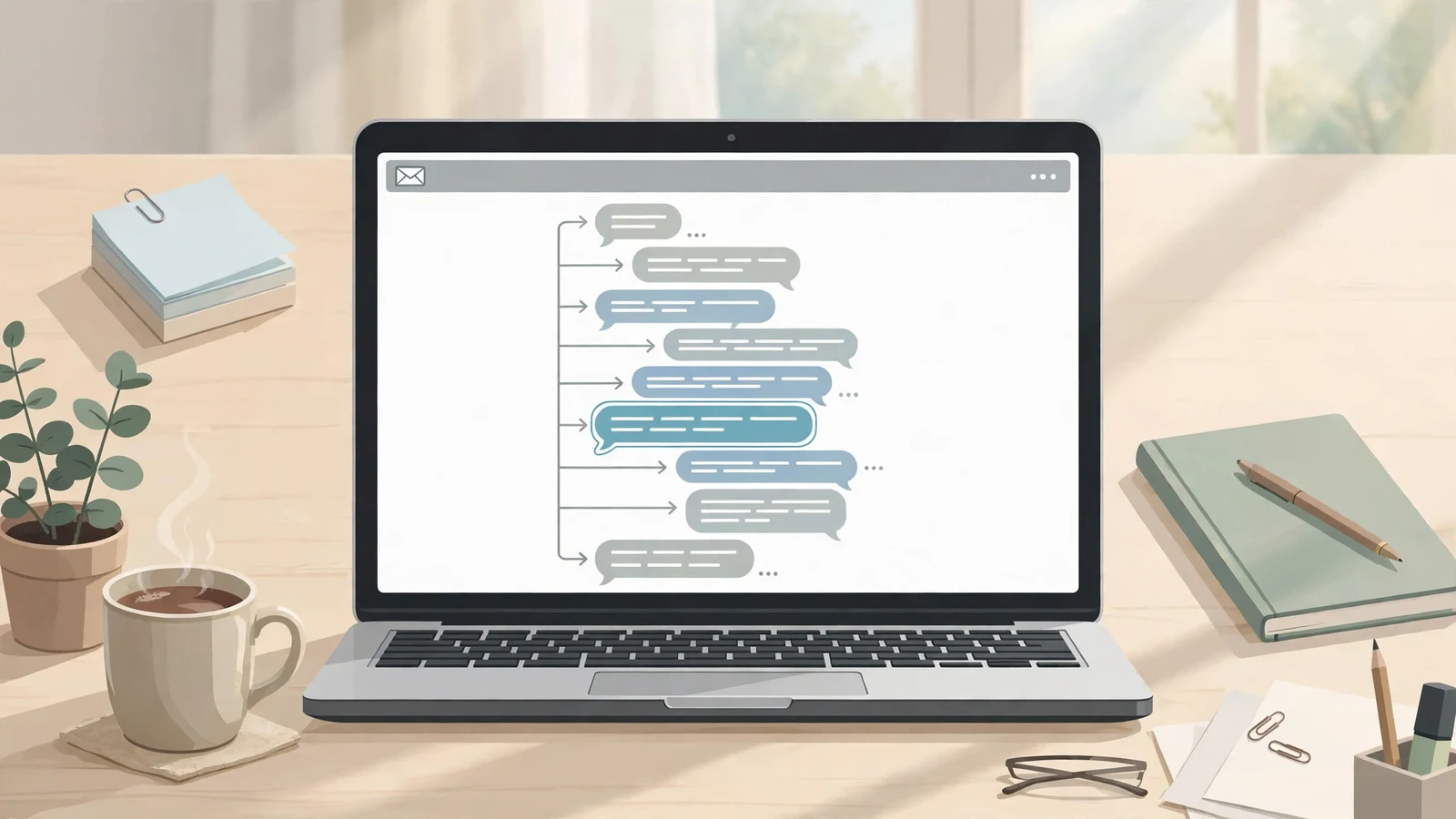
An email thread is a series of messages grouped together by your email program because they belong to the same conversation. When someone sends an original message and other people reply to it, all of those replies stay linked together. The email program usually shows them in one place, often with the newest message on top and the older messages below it. This grouping is sometimes called conversation view.
A thread has a clear structure. It starts with one subject line, and every reply keeps that subject line, usually with “Re:” added in front of it. All the people in the conversation can see the full history in order, so nobody has to search through separate messages to understand what was decided earlier. For example, if a manager sends a message about a project deadline and five team members reply with updates, those six messages form one email thread.
Threads are useful because they keep context in one place. If you join a conversation late, you can read the earlier messages and catch up quickly. If you need to check who promised what, the whole discussion is right there. Most modern email programs, including Gmail, Outlook, and Apple Mail, group messages into threads automatically.
What Is an Email Chain?
An email chain is also a series of related emails, but the emphasis is slightly different. The word “chain” suggests a sequence of links, where each message is connected to the one before it. In everyday use, an email chain often means a long series of forwarded or replied messages that have built up over time. People sometimes use the phrase when the conversation has gone on for a while, or when messages have been passed from one person to another.
For example, if an announcement is forwarded from a manager to a team leader, then to a whole department, and then to outside partners, people may call that whole sequence an email chain. The focus is on the length of the sequence and the way messages pass along from person to person, rather than on the neat grouping that an email program creates.
In casual speech, many people use “email chain” and “email thread” to mean the same thing. That is why the two terms feel interchangeable. In careful writing, however, “chain” often carries a slightly looser or longer sense, while “thread” points to the organized conversation view in an inbox.
Email Thread vs Email Chain: Key Differences
The table below gives a quick side-by-side comparison. The differences are small, but they help you pick the more precise word.
| Feature | Email Thread | Email Chain |
|---|---|---|
| Main idea | One conversation grouped together | A sequence of linked messages |
| How it is formed | Replies stay under one subject line | Messages passed along, often forwarded |
| Length | Can be short or long | Often feels long or ongoing |
| Organization | Neat, shown as one conversation | May feel loose or scattered |
| Common setting | Work inboxes, project discussions | Forwarded announcements, long discussions |
| Formality | Slightly more formal and technical | Slightly more casual |
The most important difference is the point of view. A thread describes how messages are organized. A chain describes how messages follow one after another. When you talk about your inbox and how messages are displayed, “thread” is usually the better word. When you talk about a long back-and-forth that keeps growing, “chain” can sound natural.
Examples in Everyday Use
Seeing the terms in real sentences makes the difference easier to feel.
- “Please reply to the same email thread so everyone can follow the discussion.”
- “I lost track of that email chain after twenty replies.”
- “She started a new thread for the budget question instead of mixing it into the old one.”
- “The whole chain started with one short message from the client last Monday.”
- “Can you forward me the full thread? I only received the last two messages.”
- “That chain has been going back and forth all week without a decision.”
Notice that in the first and fifth examples, “thread” fits because the speaker is talking about keeping a conversation together in one place. In the second and fourth examples, “chain” fits because the speaker is talking about a long, growing sequence. In many sentences, though, either word would be understood, and neither would be marked wrong.
Common Mistakes to Avoid
One common mistake is starting a new message instead of replying to the existing thread. When you do that, the conversation splits into two places, and people lose track of earlier decisions. Always use Reply or Reply All on the original thread when your message belongs to that conversation.
Another mistake is changing the subject line in the middle of a thread. Most email programs group messages by subject, so a new subject can break the thread into pieces. If the topic truly changes, it is better to start a new thread with a clear subject than to hijack an old one.
A third mistake is replying to a very long thread just to say “Thanks” or “Noted” to a large group. That adds noise for everyone. If only one person needs your reply, reply to that person alone. If the whole group needs to know, keep the message short.
People also sometimes confuse an email thread with an email trail. An email trail is the record of messages that shows the history of a conversation, which is close to a thread. The difference is that “trail” stresses the record or evidence of what happened, while “thread” stresses the conversation itself. In most office writing, “thread” is the safer choice.
When to Use Each Term
Use “email thread” when you are talking about:
- A conversation grouped in an inbox
- Replying to the same discussion
- Keeping messages organized under one subject
- Technical or formal workplace writing
Use “email chain” when you are talking about:
- A long series of messages passed along over time
- Forwarded messages moving from person to person
- Casual conversation about a discussion that keeps growing
If you are unsure, “email thread” is the safer default in professional writing. It is the term most email programs and style guides use, and it is almost never wrong. “Email chain” is best kept for informal contexts or when you want to stress length and sequence.
Tips for Managing Email Threads Well
Good thread habits save time for everyone. First, use clear subject lines. A subject like “Q4 Budget Approval” is far easier to follow than “Quick question.” Second, keep one topic per thread. If a second topic appears, start a new thread so each discussion stays easy to find. Third, trim quoted text when you reply. Keeping the full history of a fifty-message thread in every reply makes messages heavy and hard to read; keep only the part you are answering.
Fourth, be careful with Reply All. It is useful when the whole group needs your answer, but it can flood inboxes when it is used by habit. Fifth, when a thread becomes too long or confusing, summarize the decision so far and start a fresh message with that summary. A short summary often ends a wandering thread faster than another round of replies.
Finally, remember that tone is harder to read in writing. In a long thread, short replies can sound sharp even when they are not meant that way. A brief polite sentence, such as “Thanks for the update, I agree with this plan,” keeps the conversation smooth.
How to Write a Clear Reply Inside a Thread
A good reply keeps the thread useful instead of adding to the pile. Start by reading the latest message fully before you answer, because replying to an old point that has already been settled wastes everyone’s time. Then answer at the top of your message, above the quoted history, so busy readers see your point without scrolling. Most email programs place the reply box at the top for this reason.
Keep your reply focused on one decision or question. If a thread contains three separate questions, answer each one briefly on its own line, so nothing gets missed. For example: “Budget: approved. Date: 12 May works. Venue: please confirm the hall.” This style is easy to scan and easy to act on.
When you disagree, quote only the sentence you are answering, not the entire thread. A short quote gives context without burying your reply. And when the thread has served its purpose, close it with a short summary: what was decided, who is doing what, and by when. A closing summary turns a long thread into a record people can trust, and it stops the extra “just checking” messages that keep old threads alive.
If a thread has drifted into several topics, do not try to rescue it with one giant reply. Start a fresh thread for the new topic with a clear subject line, and link back to the old thread with a single sentence: “Following up on the budget thread, here is the venue decision.” This keeps each conversation clean and searchable later.
Frequently Asked Questions
Is “email thread” or “email chain” correct?
Both are correct in English. “Email thread” is more precise for a grouped conversation in an inbox, while “email chain” stresses a long sequence of messages. Neither is a grammar error.
Can I use them interchangeably?
In casual speech, yes, most people will understand you either way. In formal or technical writing, prefer “email thread” because it matches the language email programs use.
What is the difference between a thread and a conversation?
They are very close. A conversation is the general idea of people talking. A thread is the technical grouping of those messages in an email program. Gmail calls this grouping “conversation view,” which is why the two words often overlap.
Does “email chain” mean forwarded emails only?
Not only, but forwarding is a common way chains grow. A chain can also grow through replies. The key idea is a sequence of linked messages, however they were passed along.
How do I reply so my message stays in the same thread?
Use the Reply or Reply All button on a message in the thread, and do not change the subject line. Starting a brand-new message with the same subject may not link correctly in every email program.
What should I do if a thread gets too long?
Summarize the key decisions in a new message with a fresh subject line, and ask everyone to continue there. This resets the conversation without losing the important points.
Conclusion
Email thread and email chain describe the same basic idea from slightly different angles. A thread is a conversation grouped together in your inbox, while a chain is a sequence of messages that keeps growing. In professional writing, “email thread” is the clearer and safer choice, and in casual talk “email chain” works well when you want to stress a long back-and-forth. The most important habit is not the word itself but keeping one conversation in one place, with a clear subject and only the people who need it. Master that, and the next time someone asks you to follow the thread, you will know exactly where to look.