English spelling can be confusing because many adverbs are formed by adding -ly to an adjective. When you start with the word public, it may seem natural to write publically. After all, the word already ends in -ic, and adding -ally can look familiar.
However, English does not always follow the pattern we expect.
The standard form is publicly, not publically, especially in modern American English. You will see publicly in dictionaries, formal writing, news articles, academic work, business communication, and everyday English. Oxford defines publicly as an adverb used for things done by or known to people in general. Cambridge gives a similar meaning.
This guide explains the difference between publicly or publicly, why publicly is preferred, how to use it in a sentence, common mistakes, pronunciation, and several easy examples.
Quick Answer: Publicly or Publicly?
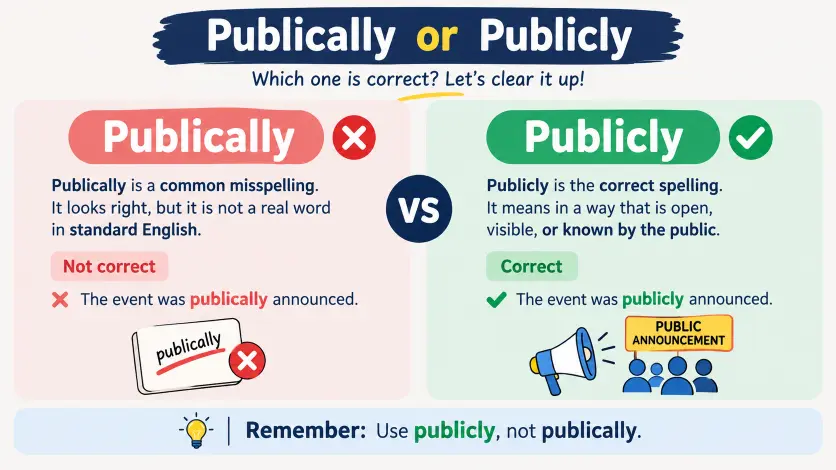
The correct standard spelling is publicly.
| Spelling | Standard modern usage | Example |
| publicly | Yes | She publicly apologized. |
| publically | Not preferred | Avoid it in standard writing. |
The word publicly is the adverb form of public.
It can mean that something happens:
- in front of other people
- openly
- where everyone can see or hear it
- in a way that becomes known to the public
- through a government or public system in some contexts
For example:
Correct: The actor publicly thanked his fans.
Less preferred: The actor publicly thanked his fans.
If you are writing an essay, email, website, report, application, or professional document, choose publicly.
What Does Publicly Mean?
Publicly is an adverb. It describes an action that is done openly or in a way that people in general can see, hear, or know about.
Cambridge defines publicly as something done so that everyone can know about it. Oxford also gives meanings connected with government ownership or funding and with things available to people generally.
Consider these examples:
The company publicly apologized for the mistake.
This means the company made its apology openly rather than keeping it private.
She publicly supported the new plan.
This means other people knew about her support.
The results were publicly available.
This means members of the public could access the results.
The exact meaning depends on the sentence, but the central idea is openness or availability to the public.
Why Is Publicly Correct?
The spelling publicly may look unusual because many words ending in -ic form adverbs with -ically.
For example:
- basic → basically
- dramatic → dramatically
- automatic → automatically
- scientific → scientifically
- realistic → realistically
Because of this pattern, writers may naturally expect:
public → publically
But public has a standard adverb form that is simply:
public → publicly
The extra a is not needed.
This is one reason the spelling can cause confusion. English has many spelling patterns, but not every word follows the same pattern.
A useful way to remember it is:
public + ly = publicly
You do not need to add -ally.
| Adjective | Standard adverb |
| public | publicly |
| basic | basically |
| dramatic | dramatically |
| automatic | automatically |
| realistic | realistically |
This does not mean every word ending in -ic behaves the same way. Instead, treat publicly as the standard spelling you need to remember.
Publicly vs. Publically: The Main Difference
The biggest difference is standard usage.
Publicly is the accepted and widely preferred spelling in contemporary standard English. Publicly may appear because some writers form it by analogy with words such as basically or automatically, but it is not the form you should normally choose in careful writing.
Here is the difference in simple terms:
| Word | Meaning | Recommendation |
| publicly | Openly or in a way known to the public | Use this |
| publically | Intended as the same meaning | Avoid in standard writing |
For example:
She publicly announced her decision.
This is the natural standard form.
You should not change the sentence to:
She publicly announced her decision.
If your goal is clear, polished American English, publicly speaking is the safer choice.
Is Publically a Word?
This question can be tricky.
People do use and write publically, and you may encounter it in older texts, informal writing, or online content. Its appearance does not mean that readers will be unable to understand it. The intended meaning is usually clear from context.
However, the important point for modern standard writing is that publicly is the established preferred spelling.
Major learner dictionaries list publicly as the adverb. Oxford’s American English dictionary gives examples such as a company being publicly owned and someone publicly apologizing.
So if a teacher, editor, employer, client, or reader expects standard English, write publicly.
Think of it this way:
Publically may be encountered, but publicly is the form to use.
Grammar: How to Use Publicly in a Sentence
Because publicly is an adverb, it usually modifies a verb. It tells the reader how, where, or in what manner an action happens.
Look at this sentence:
The manager publicly apologized to the customers.
The verb is apologized.
The adverb publicly tells us that the apology was made openly.
Another example:
The school publicly announced the winners.
Here, publicly explains how the school announced the winners.
You can place publicly in different positions depending on the sentence.
She publicly criticized the decision.
She criticized the decision publicly.
Both sentences are understandable and grammatical. The first position is often more natural when the writer wants to connect the adverb closely with the action.
More examples include:
The company publicly denied the claim.
The singer publicly thanked her fans.
The team publicly shared the results.
He publicly accepted responsibility.
The organization publicly released the report.
Common Uses of Publicly
The word publicly appears in many types of writing. You may see it in news reports, business documents, social media discussions, school writing, government information, and everyday conversation.
One common use is to describe something that is openly said.
He publicly admitted his mistake.
Another use describes something available to everyone.
The information is publicly available.
It can also describe government funding or ownership.
The project is publicly funded.
Oxford lists meanings involving government ownership or funding, as well as information intended for people generally.
You can also use it publicly when someone makes a statement where many people can see or hear it.
She publicly defended her decision.
The word does not automatically mean something is physically outside. It is often about visibility, knowledge, access, or openness.
Publicly in American English
In American English, publicly is the normal standard spelling.
Oxford’s Advanced American Dictionary includes publicly as the adverb form of public. Its examples include phrases such as “publicly owned” and “publicly apologized.”
This is useful if you are writing for a U.S. audience.
For American English content, such as:
- blog posts
- school assignments
- business emails
- websites
- news writing
- professional reports
- resumes
- marketing content
use publicly.
There is no need to use publically simply because it may seem to follow a spelling pattern.
Publicly in British English
British English is also used publicly.
This is important because the difference between American and British English does not explain the spelling choice here. Some words have different spellings across these varieties, such as color/colour or organize/organise in systems where those variants are accepted.
But publicly is standard in both American and British English.
Oxford lists publicly as the adverb form.
So you do not need to switch to publically when writing for a British audience.
The safest standard form remains:
publicly
Publicly and the Word Public
To understand publicly, it helps to understand the public.
The word public can work as an adjective or noun.
As an adjective, it can describe something connected with ordinary people or something open to people generally.
For example:
The library is a public building.
The meeting is open to the public.
The company issued a public statement.
As a noun, the public means ordinary people in society generally.
For example:
The museum is open to the public.
Oxford defines the public as ordinary people in society in general and gives examples involving public access and public knowledge.
When you turn public into an adverb, the standard form is:
publicly
So you get:
public → publicly
That is the form to remember.
Publicly vs. Openly
Publicly and openly can sometimes be used in similar situations, but they are not always identical.
Publicly focuses on the fact that something is known, seen, heard, or available to the public.
Openly often focuses on the manner of behavior—without hiding something.
Compare these examples:
She publicly announced her decision.
This tells us that the announcement was made to the public.
She openly discussed her concerns.
This emphasizes that she did not hide her concerns.
Sometimes both words can work:
He publicly criticized the proposal.
He openly criticized the proposal.
The meanings overlap, but the emphasis can differ.
If the key idea is “known by or visible to the public,” publicly is often the better choice.
Publicly vs. Privately
The opposite of publicly is often privately.
Compare:
They discussed the issue publicly.
This suggests that other people could know about or hear the discussion.
They discussed the issue privately.
This suggests that the discussion was not open to the public.
This contrast makes the meaning easy to remember.
| Public action | Private action |
| publicly announced | privately discussed |
| publicly shared | privately shared |
| publicly available | privately available |
| publicly criticized | privately criticized |
| publicly supported | privately supported |
Oxford gives privately as the opposite of publicly in meanings related to public availability and government use.
Common Mistakes With Publically or Publicly
One common mistake is adding -ally automatically.
A writer may think:
public + ally = publically
But that is not the standard spelling you want.
Another mistake is using publicly when the writer actually means public.
For example:
The public library is open today.
This is incorrect because the library needs an adjective.
The correct sentence is:
The public library is open today.
Here, the public describes the library.
But:
The library is publicly accessible.
Here, publicly modifies accessible.
These two words have different grammatical jobs.
Public
The public library is busy.
Publicly
The library is publicly accessible.
That distinction can help prevent many errors.
Real-Life Examples of Publicly
Here are simple examples that show how publicly works in everyday English.
The company publicly apologized for the error.
The apology was made openly.
The information is publicly available online.
People generally can access the information.
The mayor publicly announced the new project.
The announcement was made openly to the public.
She publicly thanked everyone who helped her.
Her thanks were expressed where other people could know about them.
The organization publicly released its report.
The report was made available to the public.
He refused to publicly discuss the matter.
He chose not to discuss it openly.
The scientist publicly explained the results.
The explanation was given openly.
The school publicly recognized the students.
The recognition was made known to other people.
Notice that publicly connects naturally with verbs such as announce, apologize, thank, support, criticize, release, discuss, recognize, deny, admit, and share.
More Examples: Publicly in Different Contexts
The word appears across many areas of life.
In business:
The company publicly announced its new policy.
In education:
The university publicly released the research findings.
In entertainment:
The actor publicly thanked the audience.
In government:
The agency publicly shared the new guidelines.
In social media:
She publicly responded to the comment.
In everyday conversation:
He publicly apologized for being late.
In technology:
The software is publicly available.
In research:
The data was publicly accessible.
In finance:
The company is publicly traded.
These examples show why publicly is a useful word. Its meaning stays connected to the idea of something being open, known, accessible, or connected with the public.
Publicly Available vs. Publicly Accessible
Two phrases that often appear in professional and online writing are publicly available and publicly accessible.
They are closely related, but there can be a small difference.
Publicly available generally means that information or a resource is available for members of the public to obtain or view.
Example:
The report is publicly available on the website.
Publicly accessible emphasizes the ability to access something.
Example:
The database is publicly accessible.
Both expressions are common and useful.
Oxford gives examples such as “publicly available” and “publicly accessible,” showing how publicly can describe information and services available to people generally.
Publicly Funded and Publicly Owned
You may also see publicly funded and publicly owned.
These phrases have a more specific meaning.
Publicly funded generally means funding comes from public or government sources.
For example:
The program is publicly funded.
Publicly owned means that something is owned by a government or public body in the relevant context.
For example:
The hospital is publicly owned.
Oxford specifically lists government-related meanings for publicly, including public funding and public ownership.
This is different from simply saying something is visible to everyone.
So publicly can have more than one closely related meaning depending on the context.
Pronunciation of Publicly
Publicly is pronounced roughly like:
PUB-lick-lee
The pronunciation is /ˈpʌblɪkli/ in the Oxford and Cambridge dictionary entries.
Breaking it into simple parts can help:
public + ly
The word does not need an extra syllable from an -ally ending.
That can make the standard spelling easier to remember.
If you already say publicly naturally, connect the pronunciation with the spelling:
publicly → PUB-lick-lee
How to Remember Publicly
If you often forget whether to write publicly or publically, use a simple memory trick.
Think:
PUBLIC + LY = PUBLICLY
Do not add an extra A.
You can also connect it with familiar phrases:
publicly available
publicly known
publicly announced
publicly funded
publicly owned
These common phrases reinforce the standard spelling.
Another helpful trick is to remember the contrast:
publicly ↔ privately
Both are adverbs and both end in -ly.
For example:
The decision was announced publicly, not privately.
That makes the spelling pattern easier to remember.
When Should You Use Publicly?
Use publicly whenever you need an adverb to describe something done openly or made known to people generally.
It is especially useful when you are describing:
- public statements
- announcements
- apologies
- criticism
- support
- information
- reports
- research
- funding
- ownership
- online access
- government actions
- public responses
For example:
The company publicly announced the change.
The report is publicly available.
She publicly supported the project.
The organization publicly apologized.
If you are unsure, ask yourself:
“Am I describing something that is done openly or made known to the public?”
If the answer is yes, publicly may be the word you need.
When Should You Avoid Publicly?
You should not use public simply because the word public appears somewhere in the sentence.
For example:
The public school opened at eight.
Here, public is an adjective.
You would not write:
The public school opened at eight.
That changes the grammar and makes the sentence incorrect.
Another example:
The public library has free computers.
Again, the public describes the library.
But:
The library is publicly accessible.
Here, publicly is the adverb.
The easiest test is to identify what word you are describing.
If you are describing a noun, you may need public.
If you are describing an action or another adjective, you may need to use it publicly.
Frequently Asked Questions
Is publicly or publically correct?
Publicly is the standard spelling used in modern English. It is the form you should use in formal, academic, professional, and everyday writing. Oxford and Cambridge list publicly as the standard adverb.
Is publically a public misspelling?
Publically is a form you may encounter, but it is not the preferred standard spelling. For careful modern English, especially in American English, use publicly.
What does publicly mean?
Publicly means openly, in a way that people generally can see, hear, know, or access. For example, “The company publicly apologized” means the company made its apology openly.
Is it publicly used in American English?
Yes. Publicly is the standard adverb in American English. The Oxford Advanced American Dictionary includes it and gives examples such as “publicly owned” and “publicly apologized.”
What is the opposite of publicly?
A common opposite is privately. For example, “They discussed the matter publicly” contrasts with “They discussed the matter privately.” The exact opposite can depend on the context.
How do you use it publicly in a sentence?
Use publicly as an adverb to describe something done openly or made known to the public. For example: “The manager publicly thanked the staff.” Here, publicly explains how the manager thanked them.
Conclusion
When choosing between publicly or publicly, the answer is simple: use publicly. It is the standard modern spelling and the form recognized by major English dictionaries, including Oxford and Cambridge.
The word publicly is an adverb that describes something done openly, made known to people generally, or available to the public. You can use it in phrases such as publicly announced, publicly available, publicly funded, and publicly owned.
Although you may see publically in some writing, it is better to avoid it when you want clear and polished standard English. The easiest rule is to remember public + ly = publicly. If you are writing for school, work, a website, or a professional audience, publicly is the spelling to choose.