If you are unsure whether to use criteria or criterion, the simple rule is this: criterion is singular, while criteria is plural. Use criteria when talking about one standard or rule, and use criteria when talking about two or more standards. For example, “Price is one criterion” is correct, while “Price and quality are two criteria” is also correct. This small grammar difference can be confusing because criterion and criteria come from Greek and do not follow the common English pattern of simply adding “s” to make a plural.
In this guide, you will learn exactly when to use criteria or criterion, how to remember the difference, common mistakes to avoid, and how these words work in everyday and professional English.
Quick Answer: Criteria or Criterion?
The difference between criterion and criteria is mainly about numbers.
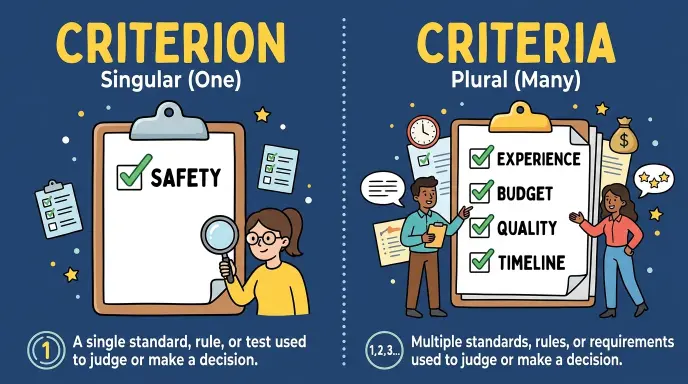
Criterion is a singular noun. It means one standard, rule, condition, or measure used to make a decision or judgment.
Criteria is the plural form of criterion. It means two or more standards, rules, conditions, or measures.
Here is the easiest way to remember it:
| Word | Number | Meaning | Example |
| Criterion | Singular | One standard | Cost is an important criterion. |
| Criteria | Plural | Two or more standards | Cost and quality are important criteria. |
For example, imagine you are choosing a new laptop. If battery life is the only standard you are considering, battery life is one criterion.
If you consider battery life, price, screen quality, and storage, these are several criteria.
So, when choosing between criteria or criterion, first ask yourself: Am I talking about one standard or more than one?
Meaning and Definition of Criterion
The word criterion refers to a standard that you use to judge, compare, evaluate, or decide something.
In simple terms, a criterion is a rule or point that helps you decide whether something meets a certain level.
For example:
“Experience is an important criterion for this job.”
The sentence means that experience is one standard used to evaluate job applicants.
Another example is:
“Safety is the main criterion for choosing the equipment.”
Here, safety is one standard used to make the decision.
The word can be used in many areas, including education, business, hiring, science, research, shopping, and everyday decision-making.
You might see sentences such as:
“Accuracy is an important criterion for the test.”
“Age is one criterion for joining the program.”
“Quality was the main criterion used by the judges.”
In each example, the writer is talking about one standard.
A useful synonym for criterion is standard, although the exact meaning can change slightly depending on context.
Meaning and Definition of Criteria
Criteria is the plural form of criterion.
It refers to two or more standards used to evaluate, compare, select, or judge something.
For example:
“The company has strict criteria for hiring new employees.”
This means the company has several standards for hiring employees.
Those standards might include education, work experience, skills, and communication ability.
Here is another example:
“The judges used several criteria to select the winner.”
The judges did not use just one standard. They used several standards.
Other examples include:
“The school has clear criteria for admission.”
“We need to meet all the criteria before applying.”
“The product meets the required safety criteria.”
“Price and quality are important criteria when buying a car.”
Because criteria is plural, it normally refers to more than one condition or standard.
The Main Grammar Difference Between Criterion and Criteria
The most important grammar point is simple:
Criterion = one
Criteria = more than one
This is similar to other singular and plural word pairs, but the form is unusual.
You would say:
“One criterion”
“Two criteria”
“Several criteria”
“Many criteria”
“An important criterion”
“An important criterion” refers to one standard.
“Several important criteria” refers to multiple standards.
Compare these sentences:
“Price is an important criterion.”
“Price and quality are important criteria.”
The first sentence uses criterion because only one standard is mentioned.
The second uses criteria because two standards are mentioned.
This difference also affects the verb.
For example:
“The main criterion is cost.”
“The main criteria are cost and quality.”
Notice the difference between is and are.
| Correct Form | Why? |
| One criterion is required. | Criterion is singular. |
| Several criteria are required. | Criteria is plural. |
| This criterion is important. | One criterion. |
| These criteria are important. | Multiple criteria. |
| The criterion was difficult to meet. | Singular noun. |
| The criteria were difficult to meet. | Plural noun. |
Understanding the number of the noun makes the correct verb much easier to choose.
Why Is the Plural of Criterion Criteria?
The unusual plural form comes from the history of the word.
Criterion comes from Greek. English borrowed the word through other languages, and its plural form developed as criteria.
Many English words that come from Greek or Latin keep older plural patterns.
This is why we do not normally make the plural by adding “s” and writing criterions.
In standard modern English, criteria is the normal plural form of criterion.
The same pattern appears with some other words borrowed from classical languages. For example, phenomenon has the plural phenomena, and datum has the plural data in formal usage.
You do not need to know the full history to use the word correctly, though. The most useful rule is simply:
Criterion = one. Criteria = more than one.
Can Criterion Be Used for More Than One Thing?
No. In standard English, the criterion is singular.
For example:
“The three criteria are important.”
This is incorrect in standard English.
The correct sentence is:
“The three criteria are important.”
Likewise:
“We have several criteria.”
is incorrect.
Use:
“We have several criteria.”
The word several clearly tells us that more than one item is involved, so the plural criteria is needed.
A quick test is to replace the word with standard or standards.
If you would say “one standard,” use criterion.
If you would say “several standards,” use criteria.
Can Criteria Be Singular?
In standard formal English, criteria is plural.
So this sentence is incorrect:
“Price is an important criteria.”
The correct version is:
“Price is an important criterion.”
Why?
Because price is one standard.
Now compare:
“Price and quality are important criteria.”
Here, there are two standards, so the criteria is correct.
This mistake is common because many English speakers hear criteria so often that they may treat it as a normal singular word.
However, in careful standard English, criterion is the singular form.
Common Mistakes With Criteria and Criterion
One of the most common mistakes is using criteria when only one standard is meant.
For example:
“Cost is the most important criteria.”
The correct version is:
“Cost is the most important criterion.”
Another common mistake is using criteria when several standards are being discussed.
For example:
“The company uses three criteria to evaluate applicants.”
The correct sentence is:
“The company uses three criteria to evaluate applicants.”
A third mistake is choosing the wrong verb.
For example:
“The criteria is difficult to understand.”
In standard English, the better form is:
“The criteria are difficult to understand.”
Since criteria is plural, it normally takes a plural verb.
Here are some common mistakes:
| Incorrect | Correct | Reason |
| One criteria | One criterion | One = singular |
| Two criterion | Two criteria | Two = plural |
| The criteria is clear | The criteria are clear | Criteria is plural |
| These criterion matter | These criteria matter | These = plural |
| Price is a criteria | Price is a criterion | One standard |
| Several criterion are used | Several criteria are used | Several = plural |
Real-Life Examples of Criterion
The word criterion appears in many real-life situations.
In education, you might hear:
“Attendance is one criterion for passing the course.”
In hiring:
“Previous experience is an important criterion for the position.”
In business:
“Profitability is one criterion used to evaluate the project.”
In science:
“Accuracy is an important criterion for the experiment.”
In shopping:
“Battery life was my main criterion when choosing a phone.”
In sports:
“Fitness was one criterion used to select the players.”
Each sentence describes one standard.
You can often replace criterion with “one standard” and keep the basic meaning.
For example:
“Experience is one criterion for the job.”
can be understood as:
“Experience is one standard for the job.”
Real-Life Examples of Criteria
Now look at examples where more than one standard is involved.
“The company has strict criteria for promotion.”
“The judges considered several criteria before choosing the winner.”
“Price, quality, and durability are important criteria when buying furniture.”
“The application must meet all eligibility criteria.”
“The teacher gave us clear criteria for the project.”
“Safety and performance were the main criteria.”
In each sentence, there is more than one standard, condition, or measure.
A useful clue is that words such as several, many, different, multiple, all, these, and those often appear with criteria.
For example:
“Several criteria”
“Multiple criteria”
“All criteria”
“These criteria”
“Different criteria”
These combinations usually make the plural meaning clear.
Criteria or Criterion in Academic Writing
Both words are very common in academic writing.
Researchers, teachers, and students often use criteria when explaining how something is evaluated.
For example:
“The study used three criteria to select participants.”
A writer might then explain those criteria as age, location, and previous experience.
When only one standard is involved, criterion is appropriate.
For example:
“Reliability was the primary criterion for selecting the measurement tool.”
Academic writing often uses these words because researchers need to describe how they judge data, sources, participants, or results.
For example:
“The researchers established clear criteria before beginning the study.”
This means they created multiple standards.
Another example:
“Validity was one important criterion.”
Only one standard is being discussed in that sentence.
Criteria or Criterion in Business and Work
The words criteria and criterion are also common in workplaces.
Managers may use criteria to evaluate employees, applications, projects, or suppliers.
For example:
“We have several criteria for selecting a supplier.”
Those criteria could include price, delivery time, quality, and reliability.
If a manager says:
“Cost is an important criterion,”
The manager is referring to just one standard.
Job advertisements can also use these words.
For example:
“Communication skills are one criterion for this role.”
More naturally, if several requirements are listed, you might see:
“The company has several criteria for selecting candidates.”
Understanding this distinction can make professional writing clearer and more precise.
Criteria or Criterion in Everyday English
You do not need to use these words only in formal writing.
They can also appear in everyday conversations.
Imagine someone is choosing a restaurant.
They might say:
“Location is my main criterion.”
That means location is the main standard they are using.
If they say:
“Price, location, and food quality are my main criteria,”
They are talking about three standards.
Another example is choosing a vacation destination.
You could say:
“Safety is an important criterion.”
Or:
“Safety, cost, weather, and travel time are my main criteria.”
The words may sound formal, but their basic meaning is simple.
How to Remember the Difference
A simple memory trick can help you remember criteria or criteria.
Think:
Criterion = one
Criteria = many
You can also remember the endings:
-on → singular
-a → plural
This is not a rule that works for every English word, but it works for this pair.
Another useful trick is to connect criterion with the word one:
one criterion
Then connect criteria with numbers greater than one:
two criteria
three criteria
many criteria
If you practice these combinations, the difference becomes much easier to remember.
Criteria vs. Criterion: A Quick Comparison
Here is a complete comparison:
| Feature | Criterion | Criteria |
| Number | Singular | Plural |
| Meaning | One standard | Two or more standards |
| Example | Cost is one criterion. | Cost and quality are criteria. |
| Article | A criterion / the criterion | The criteria |
| Common verb | Is | Are |
| Example with “several” | Not normally used | Several criteria |
| Example with “one” | One criterion | Not normally used |
The most important point is not the spelling. It is the number.
When you see one standard, choose a criterion.
When you see multiple standards, choose criteria.
Is “Criterions” Correct?
The word criterions can be found in some English usage, but it is not the normal plural form most writers should use.
For standard modern English, criteria is the established plural of criterion.
If you are writing an essay, report, website, business document, academic paper, or professional email, criteria is the safer and more widely accepted plural form.
For example, write:
“The researchers established several criteria.”
rather than:
“The researchers established several criterions.”
Using criteria will also sound more natural to most readers.
British vs. American English
The distinction between criterion and criteria is generally the same in both American and British English.
American English uses:
“One criterion”
“Several criteria”
British English also uses:
“One criterion”
“Several criteria”
So this is not mainly a US-versus-UK spelling issue.
If you are writing for an American audience, you do not need to change the rule. Use criteria for one and criteria for more than one.
This makes the pair easier to learn because the basic grammar remains consistent across the two major varieties of English.
When Should You Use Criterion?
Use criterion when you are talking about a single standard, condition, rule, or measure.
For example:
“Quality is the main criterion.”
“Age is one criterion for admission.”
“Accuracy was the most important criterion.”
“The final criterion was cost.”
A helpful question is:
How many standards am I talking about?
If the answer is one, use criteria.
You can also look for singular words such as:
“a”
“one”
“this”
“the main”
“the most important”
These words often signal that the noun is singular, although context should always guide your choice.
When Should You Use Criteria?
Use criteria when talking about two or more standards, conditions, rules, or measures.
For example:
“Price and quality are important criteria.”
“The application must meet several criteria.”
“These criteria are used to evaluate the products.”
“We considered all the criteria before making a decision.”
Words such as two, three, several, many, multiple, all, these, and those often indicate a plural noun.
Remember that criteria normally takes a plural verb:
“The criteria are…”
not:
“The criteria is…”
FAQs About Criteria or Criterion
Is criterion singular or plural?
Criterion is singular. It refers to one standard, rule, condition, or measure used to evaluate something. For example, “Cost is one criterion.”
Is criteria singular or plural?
Criteria is plural. It refers to two or more standards or conditions. For example, “Cost and quality are important criteria.”
Should I say “one criteria” or “one criterion”?
Say one criterion. Since “one” refers to a single item, the singular noun criterion is required.
Is “criteria is” grammatically correct?
In standard English, criteria is normally incorrect when criteria means multiple standards. Use criteria instead. For example, “The criteria are clear.”
What is the plural of criterion?
The standard plural of criterion is criteria. For example, “The study used several criteria.”
What is an easy way to remember criteria and criteria?
Remember criterion = one and criteria = more than one. Think of “one criterion” and “several criteria” as your two basic patterns.
Conclusion
The difference between criteria or criterion is simple once you focus on numbers. Criterion is singular and means one standard, condition, rule, or measure used to evaluate something. Criteria is plural and means two or more standards.
For example, “Price is one criterion” is correct because price is one standard. “Price and quality are important criteria” is correct because two standards are being discussed.
The most useful rule is easy to remember: criterion = one, criteria = many. When you are unsure, check whether you are discussing a single standard or several standards. This small check can prevent common grammar mistakes in essays, reports, business writing, and everyday communication. With a little practice, choosing between criterion and criteria will become natural.