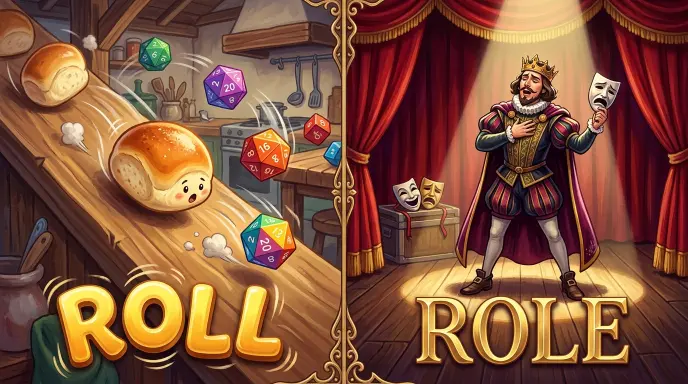
If you are unsure whether to write roll or role, remember this simple rule: roll usually describes turning, moving, wrapping, or a small round portion of something, while role describes a person’s job, part, or function. The two words sound alike in many accents, but they have very different meanings and uses.
These words are easy to mix up because they are homophones. Homophones are words that sound the same but have different spellings and meanings. When you are writing an email, school paper, social media post, or work document, choosing the wrong word can change the meaning of your sentence.
For example, you might say, “Please roll the paper,” but you would say, “She has an important role on the team.” In this guide, you will learn the difference between roll or role, how to use each word correctly, common mistakes, real-life examples, and simple tricks that can help you remember the difference.
Quick Answer
The difference between roll and role is mainly about meaning.
Roll can be a verb or a noun. It often refers to moving by turning, making something round, wrapping something, or a rounded piece of food or material.
Examples include:
“Please roll the ball toward me.”
“She ate a dinner roll.”
“Roll the dough into a thin sheet.”
Role is usually a noun. It refers to a person’s job, duty, function, part in a situation, or character in a play or movie.
Examples include:
“She plays the role of a teacher.”
“My role is to help new employees.”
“Parents have an important role in a child’s education.”
A simple way to remember it is:
Roll = move, turn, wrap, or a round thing.
Role = job, function, duty, or character.
| Word | Main Meaning | Example |
| Roll | Move by turning | The ball will roll down the hill. |
| Roll | Wrap or turn something | Roll the paper carefully. |
| Roll | A small round piece of food | I ordered a dinner roll. |
| Role | Job or function | Her role is to manage the office. |
| Role | Character in a story | He played the role of a detective. |
| Role | Part in a situation | Technology has a major role in modern life. |
Roll Meaning and Definition
Roll has several meanings, so its exact meaning depends on the sentence.
As a verb, roll often means to move by turning over and over. A ball rolls across the floor. A wheel rolls along a road. A child may roll across a bed or onto their side.
For example:
“The soccer ball rolled across the field.”
“The car began to roll slowly.”
“The puppy rolled onto its back.”
Roll can also mean to turn something around itself. You can roll a piece of paper, roll dough, roll a blanket, or roll up a poster.
For example:
“Roll the dough before cutting it.”
“She rolled the blanket and placed it in the bag.”
“He rolled up the map.”
The word can also describe something that has a round or tube-like shape.
For example:
“I bought a roll of tape.”
“She used a roll of paper towels.”
“We need another roll of toilet paper.”
In food, roll can describe a small piece of bread. You may hear phrases such as “dinner roll,” “bread roll,” or “cinnamon roll.”
For example:
“The restaurant served warm dinner rolls.”
“She made a cinnamon roll for breakfast.”
Roll also appears in several common expressions. Someone can “roll up” their sleeves, “roll over” in bed, or “roll down” a car window.
Because roll has many meanings, you should always look at the words around it to understand how it is being used.
Role Meaning and Definition
Role is mainly a noun. It describes the part someone or something has in a situation.
A role can be a job or responsibility.
For example:
“My role at the company is to train new workers.”
“Her role is to answer customer questions.”
“The manager has an important role in the project.”
Roles can also describe a character played by an actor.
For example:
“She got the role of the main character.”
“He played the role of a police officer.”
“The actor is famous for his role in the movie.”
The word can also describe the function something has.
For example:
“Exercise plays an important role in good health.”
“Education has a major role in society.”
“Communication plays a key role in teamwork.”
In these sentences, role does not mean a job title. It means the part or function that a person, activity, or thing has.
| Use of “Role” | Example |
| Job | Her role is to lead the team. |
| Responsibility | My role includes helping customers. |
| Character | He played the role of a doctor. |
| Function | Water plays an important role in farming. |
| Part in a situation | Trust has a major role in friendship. |
Roll or Role in Grammar
The biggest grammar difference is that roll can work as both a verb and a noun, while role is generally used as a noun.
As a verb, roll describes an action.
Examples:
“The wheels roll smoothly.”
“Please roll the window down.”
“Roll the dough into a ball.”
As a noun, roll can describe an object or thing.
Examples:
“I need a roll of tape.”
“Please give me a dinner roll.”
“The actor read the roll of names.”
However, the last example is incorrect if you mean a list of names. The correct word is usually roll only in specific expressions such as “roll of names,” “class roll,” or “payroll,” while role refers to a function or position.
Role is normally a noun.
Examples:
“She accepted the role.”
“What is your role here?”
“He has an important role in the company.”
You generally would not use role as a verb in ordinary American English.
| Word | Common Grammar Use | Example |
| Roll | Verb | Roll the ball to me. |
| Roll | Noun | I bought a roll of tape. |
| Role | Noun | She has a leadership role. |
Understanding this basic grammar difference makes the choice much easier.
Roll or Role: Real-Life Examples
Seeing both words in everyday sentences can make the difference clearer.
Consider these examples:
“The ball will roll down the stairs.”
Here, roll describes movement.
“She has a leadership role.”
Here, role describes a position or responsibility.
“Please roll the dough.”
Again, roll describes an action.
“He played the role of a doctor.”
Here, the role describes a character.
“The dog rolled onto the grass.”
The dog moved by turning its body.
“Parents play an important role in education.”
Parents have an important function or responsibility.
“I packed two dinner rolls.”
Here, rolls are pieces of bread.
“She accepted the role of team captain.”
The word refers to her position on the team.
These examples show why spelling matters. The words may sound alike, but replacing one with the other can produce a different meaning.
Common Mistakes With Roll and Role
One common mistake is using roles when talking about physical movement.
Incorrect:
“Please roll the ball to me.”
Correct:
“Please roll the ball to me.”
The ball moves by turning, so roll is correct.
Another common mistake is using roll when talking about a job or responsibility.
Incorrect:
“She has an important role in the company.”
Correct:
“She has an important role in the company.”
The sentence describes her function at work, so role is correct.
The same problem appears when talking about actors.
Incorrect:
“He got the roll of the villain.”
Correct:
“He got the role of the villain.”
An actor gets a role, because a role is a character or part in a production.
| Incorrect | Correct | Why? |
| She has an important role at work. | She has an important role at work. | Role means responsibility or function. |
| Roll the ball to me. | Roll the ball to me. | Roll means move by turning. |
| He played the roll of a king. | He played the role of a king. | Role means a character. |
| Roll the dough flat. | Roll the dough flat. | Roll describes the action. |
| My bread is fresh. | My roll of bread is fresh. | Roll can mean a piece of bread. |
Another useful tip is to look at the noun that follows the word.
If you are talking about a job, responsibility, position, or character, you probably need a role.
If you are talking about movement, turning, wrapping, or a round object, you probably need to roll.
Roll or Role in Work and Business
The word role is very common in workplaces.
People often talk about their role, job role, professional role, or role within a team.
For example:
“My role is to manage the website.”
“She has a customer service role.”
“His role includes training new employees.”
“The team needs someone to take on a leadership role.”
In business writing, role often describes responsibilities rather than a physical job title.
For example, a person might have the job title “Marketing Manager,” but their role may include planning campaigns, reviewing content, and communicating with customers.
Roll can also appear in business, but it has a different meaning.
For example:
“The printer uses a roll of paper.”
“The company ordered a new roll of labels.”
“The wheels began to roll.”
So, if you are writing about someone’s responsibilities at work, role is almost always the word you want.
Roll or Role in Movies, Books, and Theater
The word role is especially common in entertainment.
Actors play roles. A role can be large, small, serious, funny, dramatic, or supporting.
For example:
“She played the role of a detective.”
“He was offered the lead role.”
“The actor accepted a supporting role.”
“The character’s role becomes important later in the story.”
The spelling roll is incorrect when you mean an acting part.
You might remember this by thinking about the word role = character.
Roll can still appear in entertainment, but it means something else.
For example:
“The camera began to roll.”
Here, roll means that the camera started recording.
You might also hear:
“Let’s roll!”
This informal expression can mean “Let’s go” or “Let’s begin.”
The two words can therefore appear in the same movie-related conversation, but their meanings remain different.
Roll or Role in Common Expressions
Both words appear in many everyday expressions.
Common expressions with roll include “roll over,” “roll up,” “roll down,” “roll out,” and “roll with it.”
For example:
“Roll up your sleeves.”
“Roll down the window.”
“The company plans to roll out a new product.”
“Just roll with it.”
The word role also appears in common phrases.
Examples include:
“role model”
“lead role”
“supporting role”
“leadership role”
“important role”
“key role”
“social role”
“professional role”
For example:
“She is a great role model for younger students.”
“He has a key role in the project.”
These expressions all relate to a person’s function, position, character, or influence.
Roll or Role in American English
In American English, roll and role are both standard words, but they serve different purposes.
The spelling does not change simply because you are writing American English. The same basic distinction applies in British English and other varieties of English.
For example:
American English:
“She played the role of a doctor.”
British English:
“She played the role of a doctor.”
Both use roles.
Likewise:
“Roll the ball across the floor.”
The word remains roll.
The main challenge is not an American-versus-British spelling difference. It is recognizing the meaning of each word.
How to Remember the Difference Between Roll and Role
A simple memory trick can help.
Think of roll as something that moves or turns.
A ball can roll.
A wheel can roll.
Dough can roll.
A person can roll over.
A piece of bread can be a roll.
Think of a role as something connected to a responsibility or character.
A person can have a role at work.
A student can have a role in a group.
An actor can play a role.
A parent can have an important role in a child’s life.
You can also remember this short rule:
Roll = action or round thing.
Role = part or responsibility.
When you pause for a second and identify the meaning, the correct spelling usually becomes obvious.
Roll or Role in Sentences
Here are more examples to help you practice.
“The coin rolled across the table.”
The coin moved by turning, so roll is correct.
“She has a major role in the organization.”
The word describes her function, so role is correct.
“Please roll the sleeping bag.”
This describes an action, so roll is correct.
“He played the role of a firefighter.”
This describes an acting part, so the role is correct.
“We bought fresh rolls from the bakery.”
These are pieces of bread, so rolls are correct.
“Teachers have an important role in schools.”
This describes their function, so the role is correct.
“The wheels started to roll.”
The wheels move by turning, so roll is correct.
“What role does technology play in education?”
The question asks about technology’s function, so the role is correct.
These examples cover some of the most common situations where writers confuse the two words.
Roll or Role: A Simple Comparison
The following table gives you a quick reference.
| Feature | Roll | Role |
| Part of speech | Noun or verb | Usually a noun |
| Main idea | Turn, move, wrap, or rounded item | Job, function, responsibility, or character |
| Physical movement | Yes | No |
| Job or responsibility | No | Yes |
| Acting character | No | Yes |
| Food | Yes, such as a bread roll | No |
| Example | Roll the ball. | She has a key role. |
| Memory clue | Turn or round | Part or responsibility |
The difference becomes much easier when you focus on meaning instead of pronunciation.
Why Roll and Role Sound the Same
Roll and role are commonly treated as homophones. Homophones are words that sound alike but have different meanings or spellings.
Other familiar English homophones include:
“to,” “too,” and “two”
“there,” “their,” and “they’re”
“right” and “write”
“flower” and “flour”
Like these pairs, roll and role can cause spelling mistakes because hearing the word does not tell you which spelling to use.
When someone says, “She has an important role,” you cannot identify the spelling from sound alone. You need to understand what the word means in the sentence.
That is why context is so important.
Tips for Choosing Roll or Role Correctly
When you are unsure, ask yourself what the word means.
If the sentence involves movement or turning, choose roll.
“The ball will roll.”
If the sentence involves wrapping or forming something into a round shape, choose roll.
“Roll the dough.”
If the sentence involves bread or another rounded item, choose roll.
“I ate a dinner roll.”
If the sentence involves a job or responsibility, choose a role.
“She has a management role.”
If the sentence involves an actor or character, choose a role.
“He played the role of a teacher.”
If the sentence describes the function of a person or thing, choose a role.
“Technology plays an important role in education.”
A final proofreading trick is to replace the word mentally.
If you can replace it with job, function, responsibility, or character, use role.
If you can replace it with turn, move, wrap, or bread, use roll.
FAQs About Roll or Role
What is the difference between roll and role?
Roll usually means to turn, move, wrap, or describe a rounded object or piece of food. Role usually means a job, function, responsibility, or character.
Is it “roll in a movie” or “role in a movie”?
Use role when you mean an acting part. For example, “She had a leading role in the movie.”
Is it “my role at work” or “my role at work”?
Use roles. Your role at work means your job, responsibilities, or function.
Is a bread roll spelled roll or role?
It is spelled roll. A bread roll is a small piece of bread.
Is “roll model” correct?
No. The correct expression is role model. A role model is someone whose behavior or qualities can serve as an example for others.
How can I remember roll vs. role?
Think of roll as movement, turning, wrapping, or a round thing. Think of a role as a job, responsibility, function, or character.
Conclusion
Understanding roll or role becomes simple once you focus on meaning rather than sound. Roll usually relates to turning, moving, wrapping, or a rounded item such as a bread roll. Role usually describes a person’s job, responsibility, function, or a character played by an actor.
For example, you can roll a ball across the floor, but you can have an important role on a team. You can eat a dinner roll, but an actor plays a role in a movie.
Because these words sound alike, spelling mistakes are common. The best way to avoid them is to pause and ask what you mean. If the idea involves movement or something round, think roll. If it involves a job, function, responsibility, or character, think role.
Once you learn this simple distinction, choosing the correct word becomes much easier in everyday writing.