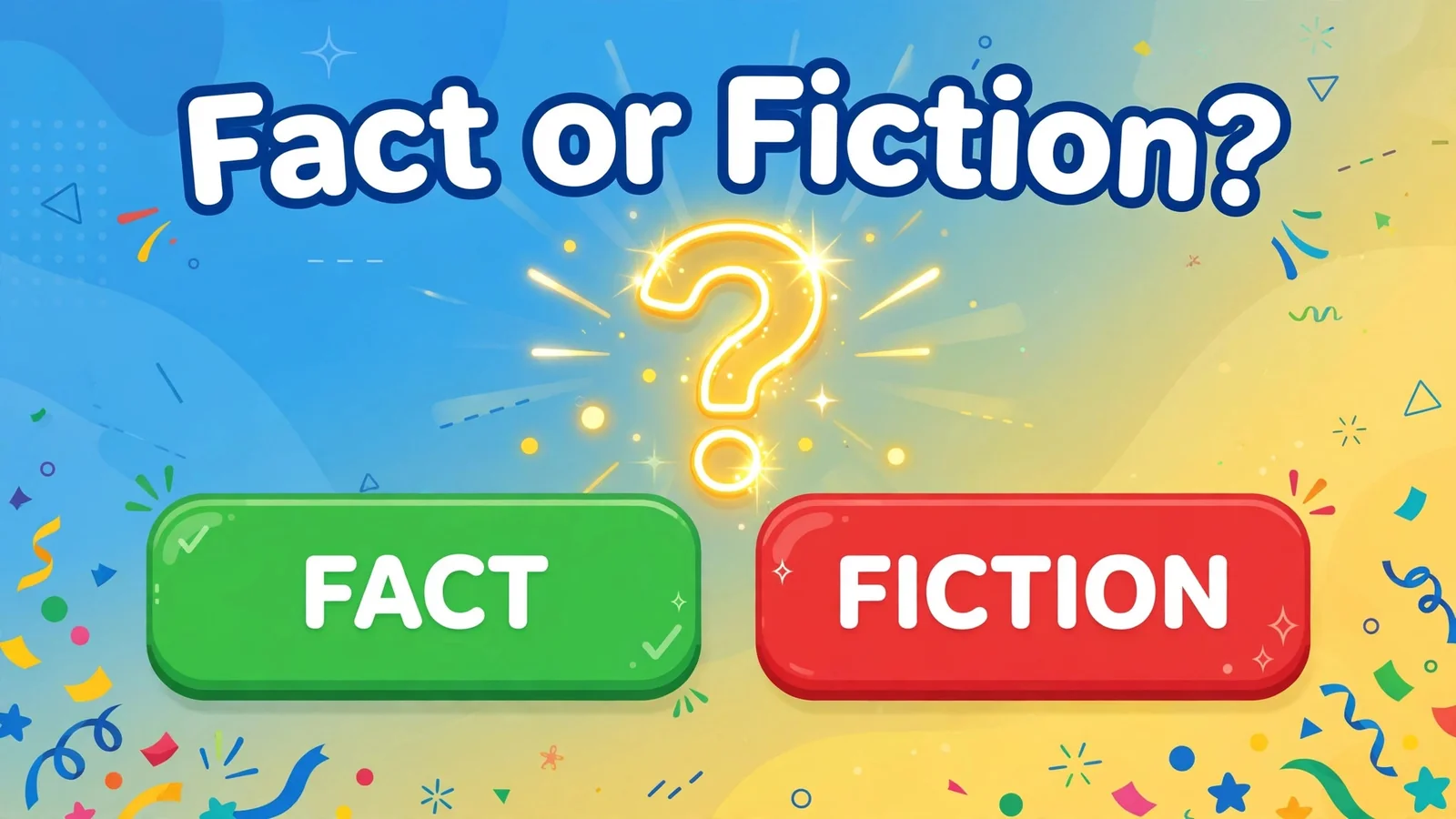
Fact or fiction questions give you a statement, and you must decide if it is true (fact) or made up (fiction). That is the whole game, and it works anywhere — in classrooms, at parties, on quiz nights, and in online videos. Some statements sound too strange to be true but are real facts. Others sound completely true but are invented. This simple guessing challenge tests your knowledge, your logic, and your gut feeling at the same time. In this guide, you will learn what fact or fiction questions are, how the game works, the rules, ready-to-use question lists with answers, and tips for writing your own tricky questions.
Quick Answer
A fact or fiction question shows one statement. If the statement is true, the answer is “fact.” If the statement is false or invented, the answer is “fiction.” Players guess before the answer is revealed. Good questions mix surprising true facts with believable false ones, so guessing is never too easy. You can play with two people or a whole room, with points for every correct guess. No equipment is needed — just a list of statements and the answers hidden until everyone has guessed.
What Are Fact or Fiction Questions?
Fact or fiction is a guessing format that has been popular for decades in books, TV shows, board games, and school quizzes. A host reads a statement out loud. The statement may be a real fact from science, history, animals, food, sports, or everyday life. Or it may be a fiction — something that sounds real but was made up for the game.
The fun comes from the gap between what sounds true and what is true. A statement like “Octopuses have three hearts” sounds like a joke, but it is a fact. A statement like “Goldfish have a three-second memory” sounds like science, but it is fiction — goldfish can remember things for months. Players must weigh each statement carefully, because the game is designed to fool them.
Fact or fiction questions are used in many places. Teachers use them to make lessons lively. Party hosts use them as an icebreaker. Quiz channels use them in videos where viewers play along. The format also appears under other names, such as “true or false,” “fact or fake,” and “two truths and a lie” (a close cousin where one statement out of three is false).
How to Play Fact or Fiction: Step by Step
The game needs at least two people: one host and one guesser. More players make it better. The host prepares a list of statements with the correct answers marked privately.
First, the host reads one statement clearly, without giving any hint in their voice. Second, every player locks in a guess — “fact” or “fiction” — by saying it, writing it, or holding up a card. Third, the host reveals the answer and, for the best experience, explains the short story behind it. Fourth, players who guessed correctly score one point. Fifth, move to the next statement. Ten to fifteen statements make a good round. The player with the most points at the end wins.
You can also play in teams. Teams discuss each statement for twenty or thirty seconds before answering together. This version creates funny debates, because one strange detail can split a whole team.
Fact or Fiction Questions: Animals
Animal statements are perfect for this game because nature is stranger than anything we invent.
| Statement | Answer | Why |
|---|---|---|
| Octopuses have three hearts. | Fact | Two hearts pump blood to the gills, and one pumps it to the body. |
| Goldfish have a memory of only three seconds. | Fiction | Goldfish can remember things for weeks or even months. |
| A group of flamingos is called a flamboyance. | Fact | That is the real collective name for flamingos. |
| Bats are blind. | Fiction | Bats can see; they also use sound (echolocation) to hunt at night. |
| Sea otters hold hands while they sleep. | Fact | Holding hands stops them from drifting apart in the water. |
| Koalas sleep up to 22 hours a day. | Fact | Their leaf diet gives very little energy, so they rest a lot. |
| Penguins can fly underwater but not in the air. | Fact | Their wings work like flippers, and they “fly” through water. |
| A snail can sleep for three years. | Fact | Some snails sleep for very long periods when weather is too dry. |
Fact or Fiction Questions: Food, Body, and Everyday Life
Everyday topics fool people the most, because everyone thinks they already know the answers.
| Statement | Answer | Why |
|---|---|---|
| Honey never spoils. | Fact | Sealed honey found in ancient Egyptian tombs was still safe to eat. |
| Carrots help you see in the dark. | Fiction | Carrots support eye health, but they do not give night vision. |
| The Great Wall of China is visible from space with the naked eye. | Fiction | Astronauts have confirmed it cannot be seen that way. |
| Humans and giraffes have the same number of neck bones. | Fact | Both have seven neck vertebrae. |
| We use only 10 percent of our brains. | Fiction | Brain scans show nearly all parts are active over a day. |
| Bananas are berries, but strawberries are not. | Fact | In botanical terms, this is true — the definitions surprise everyone. |
| Lightning never strikes the same place twice. | Fiction | Tall buildings are struck many times every year. |
| The unicorn is the national animal of Scotland. | Fact | Scotland really chose this mythical animal as its symbol. |
Fact or Fiction vs True or False: What Is the Difference?
Fact or fiction and true or false look similar, but they feel different in play. True or false is the school-test format: plain statements, quick answers, little drama. Fact or fiction is the entertainment format: the statements are chosen or written to sound tricky, and the reveal usually comes with a short, surprising explanation.
In true or false quizzes, most statements are ordinary facts from a lesson. In fact or fiction games, the fiction statements are crafted to be believable — they copy the style of real facts, use real places and numbers, and change one key detail. That crafting is the heart of the game. A good fiction statement should fool at least half the room. A good fact statement should sound fake until the explanation lands.
Tips for Writing Your Own Fact or Fiction Questions
Writing great questions is a skill you can learn quickly. Start with real facts that sound impossible — animals, space, food, and the human body are rich sources. Then write fiction statements by taking a real fact and changing one detail: a number, a place, an animal, or a date. The closer the change is to the truth, the harder the guess.
Keep every statement short — one sentence is best. Avoid double negatives and tricky grammar, because the challenge should be the idea, not the language. Mix the order so answers do not follow a pattern like fact, fiction, fact, fiction. Write the explanation at the same time as the statement, so the reveal always teaches something. Finally, test your list on one friend before game night. If they guess everything correctly, your fiction statements need to be sneakier.
Why Fact or Fiction Questions Are Great for Learning
Teachers love this format because guessing forces the brain to think before it learns. When you commit to an answer and then discover you were wrong, the correct fact sticks in your memory much longer. Scientists call this the power of prediction and surprise.
The game also builds healthy skepticism. Players learn that a confident, detailed statement can still be false — a useful lesson in a world full of viral claims and fake news. For language learners, fact or fiction rounds offer listening practice, new vocabulary, and natural discussion, all inside a game that never feels like homework.
Common Mistakes to Avoid
The first mistake is making fiction statements too silly. If a fiction statement sounds like a joke, nobody guesses “fact,” and the round dies. The second mistake is the opposite: using facts so obscure that guessing becomes pure luck. The third mistake is reading the answer in your voice — a smile or a pause can give everything away.
Hosts also make the mistake of arguing about answers without a source. Check every fact before the game, and keep a note of where it came from. Finally, do not rush the reveal. The explanation is the best part — it is where the laughter and the learning happen.
Fact or Fiction Questions: Space and Science
Space and science statements are gold for this game, because the truth about the universe is often stranger than fiction.
| Statement | Answer | Why |
|---|---|---|
| There are more possible chess games than atoms in the known universe. | Fact | The number of chess combinations is astronomically larger. |
| The Great Wall of China is the only human-made object visible from the Moon. | Fiction | No single human-made object is visible from the Moon with the naked eye. |
| Hot water can freeze faster than cold water. | Fact | This is a real, observed effect called the Mpemba effect. |
| Sound travels faster in air than in water. | Fiction | Sound moves about four times faster in water than in air. |
| A day on Venus is longer than its year. | Fact | Venus rotates so slowly that one day outlasts its trip around the Sun. |
| Bananas are radioactive. | Fact | They contain potassium-40 — but the level is tiny and harmless. |
Notice the pattern in this list: four of the six statements sound invented but are facts. That imbalance is deliberate for one round — the next round should lean the other way, with believable fictions outnumbering the facts. Keeping players unsure about the balance is what keeps every single guess exciting.
FAQs
1. What is a fact or fiction question?
It is a statement that players must judge as true (fact) or made up (fiction). The host reveals the answer after everyone guesses, usually with a short explanation of why the answer is correct.
2. How many questions do you need for a good game?
Ten to fifteen statements make a solid round that lasts about fifteen to twenty minutes. For parties, you can prepare twenty and stop whenever the group is ready for a break.
3. Are fact or fiction questions good for kids?
Yes. Children love guessing about animals, food, and space. For younger kids, use simpler statements, read them slowly, and always explain the answer in a fun way so every round teaches something new.
4. What is the difference between fact or fiction and two truths and a lie?
In fact or fiction, each statement is judged on its own. In two truths and a lie, one player shares three statements about themselves, and the others must find the single lie among the two truths.
5. Where can I find good fact or fiction questions?
Science books for kids, animal fact collections, museum websites, and quiz books are great sources. You can also write your own by taking a real fact and changing one detail to make a believable fiction.
6. How do you make a fiction statement believable?
Copy the style of real facts: use real places, realistic numbers, and calm, confident wording. Change only one detail from the truth. The smaller the change, the harder — and funnier — the guess becomes.
Conclusion
Fact or fiction questions turn simple statements into a game of knowledge, logic, and surprise. You now know how the game works, how it differs from true or false quizzes, and how to write statements that fool even confident players. You also have two ready lists — animals and everyday life — that you can use tonight with friends, students, or family. Remember the secret of a great round: the fact should sound fake, and the fiction should sound real. Prepare your statements, hide the answers well, and enjoy the moment when the whole room gasps at the reveal.