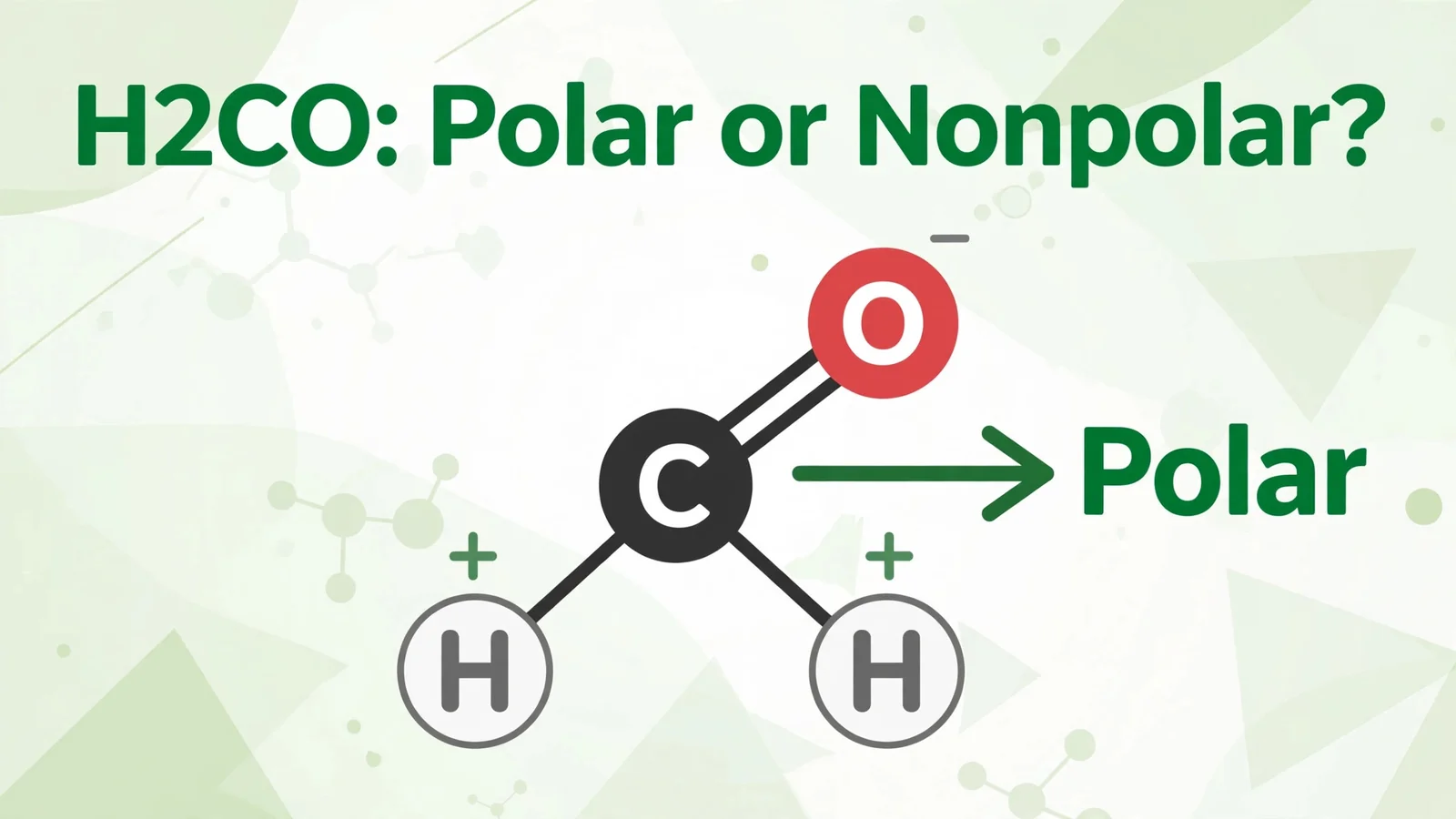
H2CO (formaldehyde) is a polar molecule. Its oxygen atom pulls electrons much more strongly than its hydrogen atoms, and its flat, uneven shape stops those pulls from canceling out. That is the short answer to the “H2CO polar or nonpolar” question. But students often get confused because the molecule looks balanced in a simple drawing — two hydrogens on one side, one oxygen on the other. In this guide, you will learn what polarity really means, how to analyze H2CO step by step, why its shape decides the answer, how its polarity explains its behavior in water and in the body, and the common mistakes that lead students to the wrong answer.
Quick Answer
H2CO is polar. The carbon–oxygen double bond is strongly polar because oxygen is far more electronegative than carbon, and the carbon–hydrogen bonds are only weakly polar. The molecule has a trigonal planar shape with bond angles of about 120 degrees, and the atoms are not arranged symmetrically around the carbon. Because of this, the bond dipoles add up instead of canceling, giving the whole molecule a net dipole moment (about 2.33 debye). The oxygen end is partly negative, and the hydrogen end is partly positive.
What Does Polar and Nonpolar Mean?
A molecule is polar when its electric charge is spread unevenly — one part of the molecule carries a slight negative charge and another part a slight positive charge. A nonpolar molecule has its charge spread evenly, so no part is clearly negative or positive.
Polarity starts inside each bond. When two atoms share electrons, the atom with the stronger pull — measured as electronegativity — drags the shared electrons closer to itself. That atom becomes slightly negative, and its partner becomes slightly positive. This separation is called a bond dipole, and we draw it as an arrow pointing toward the more negative atom.
But polar bonds alone do not guarantee a polar molecule. Shape matters just as much. If a molecule is perfectly symmetrical, its bond dipoles can cancel each other out, like two equal teams in a tug of war. Carbon dioxide is the famous example: each carbon–oxygen bond is polar, but the straight-line shape makes the two pulls cancel, so CO2 is nonpolar overall. H2CO fails this cancellation test, as the next sections show.
Meet the Molecule: What Is H2CO?
H2CO is the chemical formula for formaldehyde, the simplest aldehyde. It contains one carbon atom, two hydrogen atoms, and one oxygen atom. The carbon sits in the center. It forms a double bond with the oxygen (C=O) and single bonds with each hydrogen (C–H).
Formaldehyde is a gas at room temperature with a sharp, strong smell. It is famous as a preservative — the water solution called formalin has been used to preserve biological specimens — and as a building block in plastics, resins, and building materials. It also appears naturally in tiny amounts in the environment and even inside living cells as part of normal metabolism.
| Part of H2CO | Detail |
|---|---|
| Central atom | Carbon (C) |
| Atoms attached | 2 hydrogen (H), 1 oxygen (O) |
| Carbon–oxygen bond | Double bond (C=O) |
| Carbon–hydrogen bonds | Two single bonds (C–H) |
| Shape | Trigonal planar (flat) |
| Bond angles | About 120° |
| Common name | Formaldehyde |
Step-by-Step: Why H2CO Is Polar
Chemists judge polarity with a simple routine. Step one: compare electronegativity values. Oxygen has an electronegativity of about 3.44, carbon about 2.55, and hydrogen about 2.20. The gap between oxygen and carbon is large (about 0.89), so the C=O bond is strongly polar, with electrons pulled toward oxygen. The gap between carbon and hydrogen is small (about 0.35), so the C–H bonds are only weakly polar, with electrons pulled slightly toward carbon.
Step two: look at the shape. In H2CO, the three atoms around carbon sit in one flat plane, spread at roughly 120-degree angles — but the arrangement is not symmetrical. Oxygen occupies one corner alone, while hydrogens occupy the other two corners. There is no atom opposite the oxygen to balance its strong pull.
Step three: add up the dipoles. The strong C=O dipole points toward the oxygen. The two weak C–H dipoles point partly toward the carbon, and their combined direction also leans toward the oxygen side. Nothing cancels the oxygen’s pull. The result is a net dipole: oxygen end negative (δ−), hydrogen end positive (δ+). Conclusion: H2CO is a polar molecule.
| Bond | Electronegativity Difference | Polarity |
|---|---|---|
| C=O (carbon–oxygen) | ~0.89 | Strongly polar |
| C–H (carbon–hydrogen) | ~0.35 | Weakly polar |
| Whole molecule (H2CO) | Net dipole ~2.33 D | Polar |
H2CO vs Similar Molecules: A Helpful Comparison
Comparing H2CO with its cousins makes the rule stick. Carbon dioxide (CO2) has two polar C=O bonds, but its linear shape places the oxygens on opposite sides, so the dipoles cancel — nonpolar. Methane (CH4) has four identical C–H bonds arranged symmetrically in a tetrahedron, so its small dipoles cancel — nonpolar. Water (H2O) has two polar O–H bonds in a bent shape, so the dipoles add — polar, like H2CO.
Boron trifluoride (BF3) is the sneakiest comparison. Its B–F bonds are very polar, and like H2CO it is trigonal planar. But BF3 has three identical fluorine atoms arranged symmetrically, so its dipoles cancel perfectly — nonpolar. H2CO has two hydrogens and one oxygen, which are different, so cancellation is impossible. Symmetry needs identical atoms in balanced positions, and H2CO does not have them.
How Polarity Explains Formaldehyde’s Behavior
Polarity is not just an exam answer — it explains what formaldehyde actually does. Because H2CO is polar, it mixes extremely well with water, another polar substance. The partly negative oxygen of one molecule attracts the partly positive hydrogens of water molecules. This is why formaldehyde gas dissolves in water so easily to make formalin, the preserving liquid found in labs everywhere.
Polarity also explains why formaldehyde is so reactive in chemistry and biology. The partly positive carbon is an easy target for other molecules to attack, which is why formaldehyde reacts with proteins. That reactivity is what preserves specimens — and also what makes formaldehyde an irritant that can sting your eyes and nose. Its relatively low boiling point (about −19 °C, so it is a gas at room temperature) fits a small molecule held together by dipole forces that are present but not as strong as full hydrogen bonding.
Common Mistakes Students Make
The most common mistake is assuming that a flat, tidy drawing means a nonpolar molecule. H2CO looks balanced on paper — two hydrogens spread below, one oxygen above — but balance in a drawing is not the same as dipole cancellation. The atoms must be identical and symmetrically placed for cancellation, and oxygen is not identical to hydrogen.
Another mistake is forgetting the double bond. The C=O double bond holds more shared electrons than a single bond, and oxygen pulls all of them toward itself, making the dipole even stronger. A third mistake is judging by bonds alone without checking shape — the CO2 trap. A fourth is mixing up polar bonds with a polar molecule: a molecule needs both polar bonds AND an asymmetrical shape. H2CO has both, which is exactly why the answer is polar.
Real-Life Examples and Uses of Formaldehyde
Formaldehyde appears in more places than a chemistry lab. It is used to make plywood, particleboard, glues, and insulation resins, which is why new furniture can have a sharp smell at first. In medicine and biology, formalin preserves tissue samples and specimens. Small amounts occur naturally in some foods, in smoke, and in the air from vehicle exhaust and fires.
Health agencies treat formaldehyde carefully because its reactivity — the same property its polarity helps create — irritates eyes, skin, and airways, and long-term heavy exposure is a known health risk. Ventilation in labs and factories, and strict workplace limits, exist precisely because this little polar molecule is so active. Understanding its polarity is the first step to understanding both its usefulness and its risks.
Tips to Decide Polarity for Any Molecule
Use this routine on any molecule, in any exam. One: draw the Lewis structure so you can see every bond and lone pair. Two: check each bond’s electronegativity difference to find the polar bonds and draw dipole arrows toward the more electronegative atoms. Three: determine the shape and ask whether identical atoms sit in balanced, opposite positions. Four: if the dipoles cancel by symmetry, the molecule is nonpolar; if any net pull remains, it is polar.
Practice with the classics — CO2 (nonpolar), H2O (polar), CH4 (nonpolar), BF3 (nonpolar), NH3 (polar) — and then test yourself with H2CO. If you can explain why BF3 and H2CO differ even though both are trigonal planar, you truly understand polarity: BF3 has three identical atoms canceling out, while H2CO’s single oxygen stands alone with nothing to balance it.
A Closer Look at the C=O Bond in H2CO
It is worth pausing on the carbon–oxygen double bond, because it is the engine of H2CO’s polarity. A double bond means two pairs of electrons are shared between carbon and oxygen. Oxygen, being much more electronegative, pulls both shared pairs toward its own end of the bond. The result is a strong concentration of negative charge around the oxygen and a noticeable shortage around the carbon.
Chemists say the carbon in H2CO is electrophilic — it attracts electron-rich partners — while the oxygen is nucleophilic in character. This single fact explains a long list of formaldehyde’s chemical behaviors, from how it reacts with water to how it bonds with the amino groups in proteins. When you understand why H2CO is polar at the bond level, its reactions stop being random facts to memorize and become predictable consequences of one strong, uneven bond.
The two C–H bonds play a supporting role. Because carbon slightly out-pulls hydrogen, each hydrogen carries a small positive charge. These charges are weak on their own, but they sit on the opposite side of the molecule from the oxygen, so they reinforce the overall dipole instead of fighting it. Every part of the structure points the same way: toward a polar molecule.
FAQs
1. Is H2CO polar or nonpolar?
H2CO (formaldehyde) is polar. Its carbon–oxygen double bond is strongly polar, its shape is trigonal planar but not symmetrical, and the bond dipoles do not cancel. The molecule has a net dipole moment of about 2.33 debye.
2. Why is H2CO polar but CO2 is nonpolar?
Both have polar carbon–oxygen bonds. In CO2, the linear shape places the two oxygens on opposite sides, so their dipoles cancel. In H2CO, one oxygen stands alone opposite two hydrogens, so nothing cancels its pull.
3. What is the shape of H2CO?
Trigonal planar. The carbon atom sits in the center with the oxygen and two hydrogens arranged flat around it, with bond angles of about 120 degrees between them.
4. Which end of H2CO is negative?
The oxygen end. Oxygen is the most electronegative atom in the molecule, so it pulls the shared electrons toward itself and carries a partial negative charge (δ−). The hydrogen side carries a partial positive charge (δ+).
5. Does H2CO dissolve in water?
Yes, very easily. Formaldehyde is polar and water is polar, so they attract each other strongly. Formaldehyde gas dissolved in water forms formalin, the solution used to preserve biological specimens.
6. Is H2CO symmetrical?
No. Although it is flat with even 120-degree angles, the atoms around the carbon are not identical — two hydrogens and one oxygen. True symmetry for dipole cancellation needs identical atoms in balanced positions, like the three fluorines in BF3.
Conclusion
The H2CO polar or nonpolar question has a clear answer: H2CO is polar. Oxygen’s strong pull on the shared electrons creates a powerful bond dipole, the flat but uneven arrangement of atoms gives that pull nothing to cancel against, and the molecule ends up with a negative oxygen end and a positive hydrogen end. You now know the three-step test — electronegativity, shape, dipole addition — and you have seen how it separates H2CO from look-alikes like CO2 and BF3. Best of all, the same routine answers the polarity question for almost any molecule you will meet in class, so one small gas has taught you a tool for the whole of chemistry.