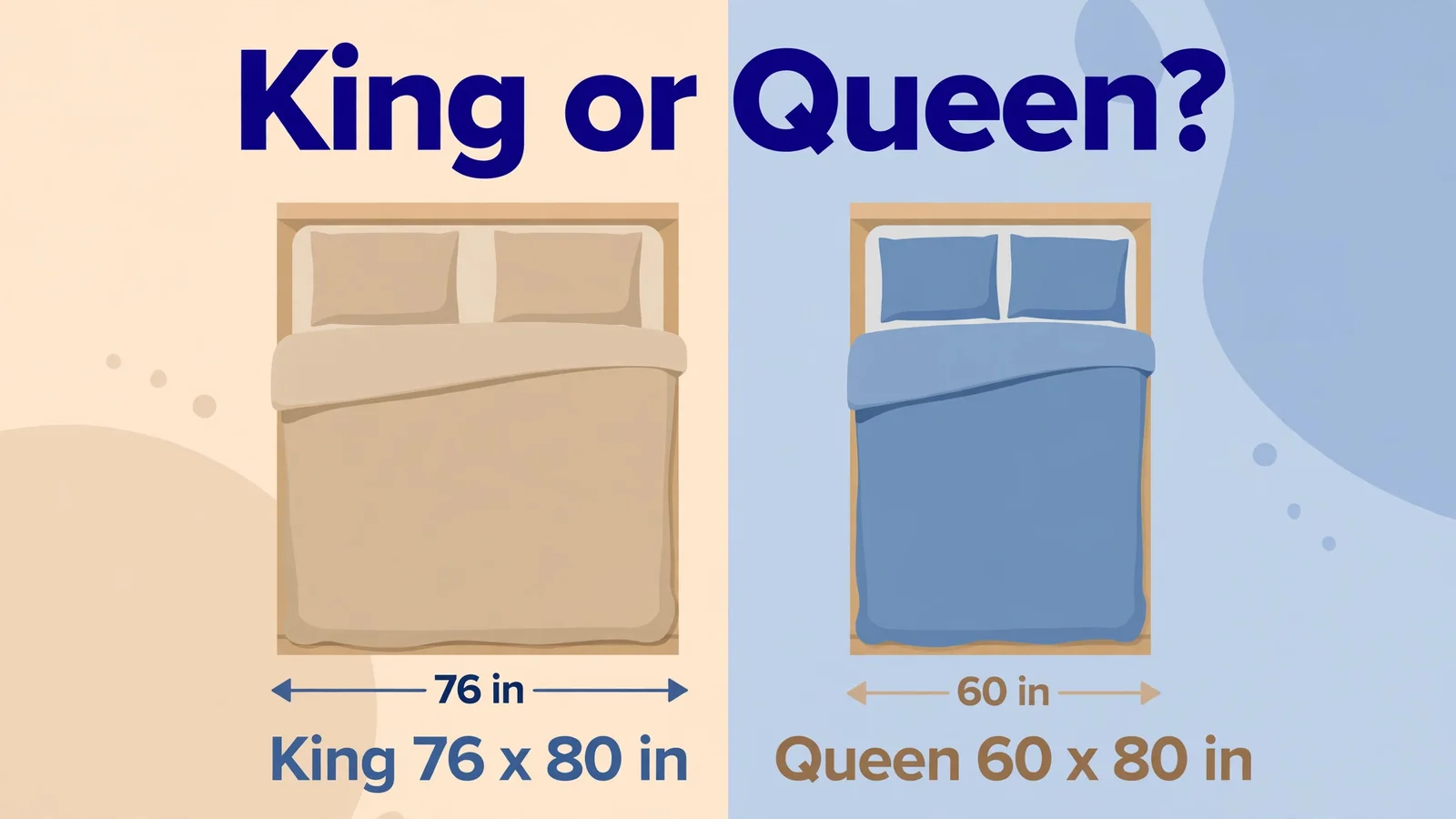
A king bed is wider, and a queen bed is longer-lasting value for most rooms — the right choice depends on your room size, how you sleep, and your budget. That is the heart of the “king or queen” question. A king-size bed measures 76 inches wide by 80 inches long, while a queen measures 60 inches wide by 80 inches long. Same length, but the king gives each sleeper 8 extra inches of width. In this guide, you will learn the exact dimensions, how much space each person really gets, which rooms fit which bed, the honest pros and cons, price differences, and a simple way to decide for your own bedroom.
Quick Answer
Choose a king if your bedroom is at least 12 by 12 feet, you share the bed and want maximum personal space, or you sleep with kids or pets joining you. Choose a queen if your room is smaller (around 10 by 10 feet works), you want to save money on the bed and bedding, or you sleep alone most nights but still want room to stretch. Both sizes are 80 inches long, so taller sleepers over about 6 feet 2 inches may prefer a California king instead, which trades width for extra length.
King vs Queen: Exact Dimensions
Numbers make this decision much easier. A standard king (also called an Eastern king) is 76 inches wide × 80 inches long. A queen is 60 inches wide × 80 inches long. The California king is 72 inches wide × 84 inches long — narrower than a king but 4 inches longer.
The most useful way to read these numbers is per-person width. A king shared by two people gives each person 38 inches of width — exactly the width of a twin bed each. A queen gives each person 30 inches — noticeably less than a twin. That 8-inch difference per person is the entire argument for the king: it is the difference between “my own space” and “we share space.”
| Bed Size | Width × Length (inches) | Width × Length (cm) | Space per Person (2 sleepers) |
|---|---|---|---|
| Queen | 60 × 80 | 152 × 203 | 30 inches each |
| King (Eastern) | 76 × 80 | 193 × 203 | 38 inches each |
| California King | 72 × 84 | 183 × 213 | 36 inches each |
Room Size: Will It Fit?
A beautiful bed in a cramped room is a daily frustration. As a rule, you want at least 24 to 30 inches of walking space on the sides and foot of the bed, plus room for dressers and doors to open. A queen fits comfortably in a room of about 10 × 10 feet or larger, which covers most standard bedrooms and guest rooms.
A king needs more air around it. A room of 12 × 12 feet is the practical minimum, and 12 × 14 feet or larger feels genuinely comfortable. In a small room, a king can swallow the space for nightstands, make changing sheets a wrestling match, and turn a simple walk to the bathroom into an obstacle course. Measure your room honestly — including radiators, closets, and doors that swing inward — before falling in love with the king.
| Room Size | Queen | King |
|---|---|---|
| 10 × 10 ft | Comfortable fit | Too tight |
| 11 × 12 ft | Roomy fit | Tight but possible |
| 12 × 12 ft | Very roomy | Minimum comfortable fit |
| 12 × 14 ft and up | Spacious | Comfortable fit |
| 13 × 16 ft and up | Spacious | Spacious, room for a bench too |
Who Should Choose a King?
Choose a king if personal space is your top priority. Couples where one partner moves a lot, sleeps hot, or works opposite shifts benefit most, because a restless sleeper disturbs the other far less with 38 inches each. Parents whose children climb in on weekend mornings, and pet owners whose dog has claimed a corner, also feel the upgrade every single night.
The king is also the better long-term comfort buy if your room allows it. You keep a bed for a decade or more, and nobody has ever complained that their bed was too wide. If you are furnishing a master bedroom for the long run and the room is big enough, the king is the classic “buy once, sleep happily” answer.
Who Should Choose a Queen?
Choose a queen if your room is modest, your budget matters, or you sleep alone. A queen gives a single sleeper a luxurious amount of space, and couples who like sleeping close often prefer it — 30 inches each is cozy, not cramped, for people who do not sprawl. Guest rooms are almost always better with a queen: it sleeps two visitors comfortably while leaving the room usable for other purposes.
The queen also wins on practical costs. Queen mattresses, frames, and bedding cost less than king versions, sheets are easier to find on sale and in more designs, and the whole setup is lighter to move — a real advantage for renters and anyone who rearranges furniture. In apartments and smaller homes, the queen is not a compromise; it is the smart fit.
Price and Bedding Differences
Expect to pay more for a king at every step. King mattresses typically cost a few hundred dollars more than the same model in queen. King bed frames, headboards, sheets, duvets, and duvet covers all carry a premium, and king bedding comes in fewer patterns and sells out faster during sales.
There are quiet ongoing costs too. King sheets are heavier in the wash and may not fit smaller machines comfortably. Making a king bed takes longer simply because there is more of it. None of this should scare you away from a king you have room for — but if the two sizes feel equal on comfort, the queen’s lower lifetime cost is a genuine point in its favor.
Sleeping Positions and Special Situations
Your sleeping style matters as much as your room. Back and stomach sleepers who spread out, and starfish sleepers who claim territory diagonally, use every inch a king offers. Side sleepers who curl up use surprisingly little width, and many couples find a queen perfectly comfortable for decades.
Consider these special cases. Tall sleepers over 6 feet 2 inches: look at the California king’s extra 4 inches of length, since both standard sizes stop at 80 inches. Couples with very different schedules: the king’s width reduces wake-ups. Small bedrooms in city apartments: the queen protects your walking space and storage. Future moves: a king is harder to carry up stairs and through narrow doors — split king frames exist for exactly this problem.
Finally, test before you commit. Lie down on both sizes in the store with your partner, in your real sleeping positions, for at least ten minutes each — small differences in width become obvious very quickly. Many mattress companies also offer home trials of 100 nights or more, which turn the king or queen decision from a guess into an experiment with a guaranteed answer.
Common Mistakes People Make
The most common mistake is buying the king for a room that cannot hold it, then living with squeezed walkways for ten years. Measure first; dream second. The second mistake is forgetting the bedding budget — the mattress price is only the start. The third mistake is ignoring the door and stair path: a king mattress that cannot reach the bedroom is an expensive hallway decoration.
People also forget to think about who actually sleeps in the bed. Buying a queen for two sprawling adults plus a large dog leads to nightly territory wars, while buying a king for a single sleeper in a big room can leave the room feeling empty and the sleeper oddly lost. Match the bed to the real sleepers, not the imagined ones.
Split King and Other Variations Worth Knowing
Once you start shopping, you will meet the king’s close relatives. A split king is not a different size at all — it is two twin XL mattresses (38 × 80 inches each) placed side by side inside one king-sized frame, totaling exactly 76 × 80 inches. Couples love it because each partner can choose a different firmness, and adjustable bases can raise one side without moving the other. It is also the practical answer to narrow stairs, since each half is easy to carry.
A Wyoming king (84 × 84 inches) and an Alaskan king (108 × 108 inches) exist for families who treat the bed as a weekend gathering place, but they need very large rooms and custom bedding. At the other end, a twin XL (38 × 80 inches) is simply half a split king, popular in dorm rooms and guest spaces.
| Variation | Size (inches) | Best For |
|---|---|---|
| Split King | 76 × 80 (two 38 × 80 halves) | Couples wanting different firmness or adjustable bases |
| Twin XL | 38 × 80 | Dorms, single sleepers, split king halves |
| Wyoming King | 84 × 84 | Families who share the bed with kids |
| Alaskan King | 108 × 108 | Very large rooms and whole-family lounging |
For almost everyone, the decision stays simple: queen for balance, king for space, California king for length. The giant variations are fun to know about, but they solve problems most bedrooms do not have.
FAQs
1. What is the difference between a king and a queen bed?
Width. A king is 76 × 80 inches and a queen is 60 × 80 inches. They are the same length, but the king gives two sleepers 38 inches each, while the queen gives 30 inches each.
2. Is a king bed worth it for couples?
For most couples with a big enough room, yes. The extra 8 inches per person means less disturbance from a partner’s movement and more comfortable sleep, especially for restless or warm sleepers.
3. What room size do you need for a king bed?
At least 12 × 12 feet, so you keep roughly two feet of walking space around the bed. A queen works comfortably in rooms as small as 10 × 10 feet.
4. King or queen: which is better for a tall person?
Neither is longer — both are 80 inches. Tall sleepers over about 6 feet 2 inches should look at a California king (72 × 84 inches), which swaps some width for 4 extra inches of length.
5. Is king bedding much more expensive than queen bedding?
Yes, noticeably. King mattresses, frames, sheets, and duvets all cost more, come in fewer designs, and can be harder to wash and handle at home. Factor bedding into the total budget before deciding.
6. Can two adults sleep comfortably in a queen bed?
Absolutely — millions do. Each person gets 30 inches of width. Couples who sleep close or curl up often find a queen cozy and warm. Sprawling sleepers or light sleepers disturbed by movement are the ones who feel the upgrade of a king most.
Conclusion
King or queen is not a question of better and worse — it is a question of fit. The king wins on personal space: 38 inches per sleeper, room for kids and pets, and the calmest shared sleep, provided your room is at least 12 × 12 feet and your budget covers pricier bedding. The queen wins on balance: comfortable for two, kind to small rooms, cheaper to buy and dress, and easy to move. You now know the exact dimensions, the per-person math, and the room rules. Measure your bedroom, count your real sleepers, and the right answer will be obvious — and you will sleep well on it for years.